Search

Ends November 13

Free instruments and big kit savings

Buy 7 Get 3 on scalers, curettes, explorers, probes and mirror handles, Buy 3 Get 1 on forceps in stock and up to $600 off complete kits. Free items come off in your cart automatically.

Buy 7 Get 3, until November 13

Buy 7, get 3 free

Mix and match any 10 scalers, curettes, explorers, probes and mirror handles. Put 10 in your cart and 3 come off automatically. Buy 20 and 6 are free.
10 at $59.99 $599.90 $419.93 You save $179.97
Categories:
PS174D

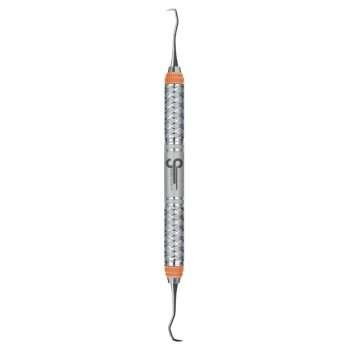
H3/H4 Jacquette Scaler

CAD 59.99
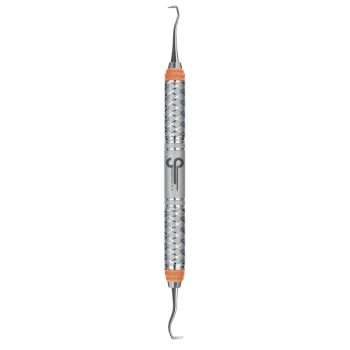
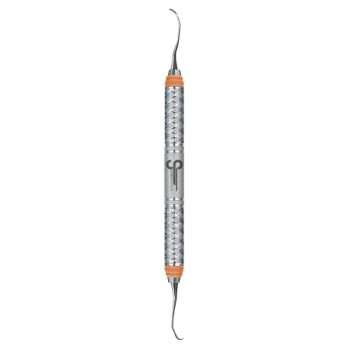
H3/H4 Jacquette Scaler is a double-ended sickle scaler with an H3 blade on one end and an H4 blade on the other. Sickle scalers are built for supragingival calculus removal: the pointed tip and triangular cross-section cut cleanly through hard deposits above the gumline, and the Jacquette blade pattern specifically adds a tighter curve suited to reaching interproximal contacts a straight sickle can't access as cleanly.With giving mirrored H-series blade angles for working both mesial and distal interproximal surfaces with one instrument, without reaching for a second scaler mid-arch, this instrument covers two related access angles on one handle, useful for a hygienist working through a full arch without reaching for a third or fourth sickle pattern mid-appointment.It's kept on the scaling tray alongside the practice's curettes, handling the initial supragingival calculus removal before curettes take over for subgingival scaling and root planing.Manufactured from medical-grade stainless steel, corrosion resistant and rated for full autoclave sterilization without losing edge sharpness or shank rigidity over repeated cycles.It's stocked alongside SurgiWorld's full range of Jacquette and Towner sickle scalers, giving a hygiene operatory the blade angle combinations needed to clear supragingival calculus efficiently across a full arch before curettes take over for subgingival work.
Categories:
PS173D

30/33 Jacquette Scaler

CAD 59.99
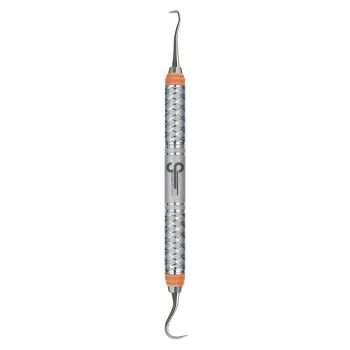
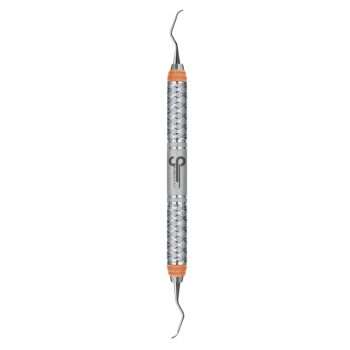
30/33 Jacquette Scaler is a double-ended sickle scaler with a 30 Jacquette blade on one end and a 33 Jacquette blade on the other. Sickle scalers are built for supragingival calculus removal: the pointed tip and triangular cross-section cut cleanly through hard deposits above the gumline, and the Jacquette blade pattern specifically adds a tighter curve suited to reaching interproximal contacts a straight sickle can't access as cleanly.With pairing two Jacquette blade angles on one handle for anterior and posterior interproximal access without switching instruments, this instrument covers two related access angles on one handle, useful for a hygienist working through a full arch without reaching for a third or fourth sickle pattern mid-appointment.It's kept on the scaling tray alongside the practice's curettes, handling the initial supragingival calculus removal before curettes take over for subgingival scaling and root planing.Manufactured from medical-grade stainless steel, corrosion resistant and rated for full autoclave sterilization without losing edge sharpness or shank rigidity over repeated cycles.It's stocked alongside SurgiWorld's full range of Jacquette and Towner sickle scalers, giving a hygiene operatory the blade angle combinations needed to clear supragingival calculus efficiently across a full arch before curettes take over for subgingival work.
Categories:
PS154D

U-15 Towner/33 Jacquette Scaler

CAD 59.99
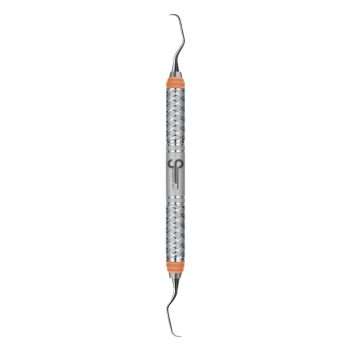
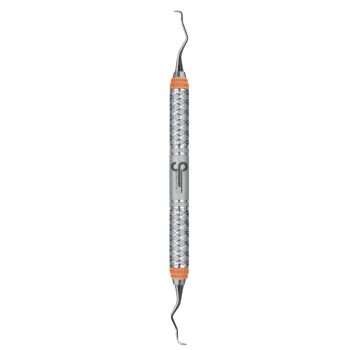
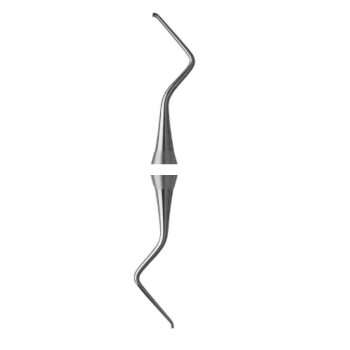
U-15 Towner/33 Jacquette Scaler is a double-ended sickle scaler with a U-15 Towner blade on one end and a 33 Jacquette blade on the other. Sickle scalers are built for supragingival calculus removal: the pointed tip and triangular cross-section cut cleanly through hard deposits above the gumline, and the Jacquette blade pattern specifically adds a tighter curve suited to reaching interproximal contacts a straight sickle can't access as cleanly.With combining broad supragingival access on one end with the 33 Jacquette's finer interproximal reach on the other, this instrument covers two related access angles on one handle, useful for a hygienist working through a full arch without reaching for a third or fourth sickle pattern mid-appointment.It's kept on the scaling tray alongside the practice's curettes, handling the initial supragingival calculus removal before curettes take over for subgingival scaling and root planing.Manufactured from medical-grade stainless steel, corrosion resistant and rated for full autoclave sterilization without losing edge sharpness or shank rigidity over repeated cycles.It's stocked alongside SurgiWorld's full range of Jacquette and Towner sickle scalers, giving a hygiene operatory the blade angle combinations needed to clear supragingival calculus efficiently across a full arch before curettes take over for subgingival work.
PCL56

5/6 Langer Curette

CAD 59.99
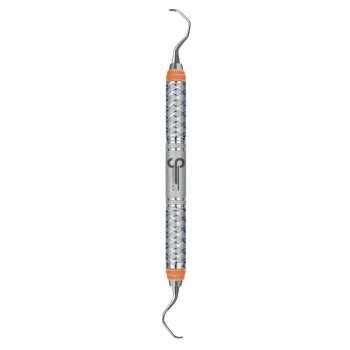
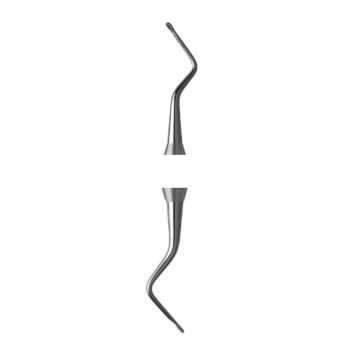
5/6 Langer Curette takes a best-of-both-worlds approach: a universal curette blade, sharp on both cutting edges, mounted on a shank built to the same angle as its Gracey counterpart - here, the shank angle of a Gracey 5/6, built for premolar and anterior facial/lingual surfaces. That combination means the clinician gets the site-specific access and angulation of a Gracey-pattern shank without being limited to a single active cutting edge the way a true area-specific curette is.It's reached for when a practice wants Gracey-equivalent access to a specific tooth group but prefers a universal blade's double cutting edge for that site, rather than stocking both a universal and an area-specific curette for the same location.The Langer series is typically kept as a complete set alongside the practice's Gracey curettes, giving hygienists a second blade option at each of the same access angles without duplicating the area-specific single-edge design.Manufactured from medical-grade stainless steel, corrosion resistant and rated for full autoclave sterilization without losing edge sharpness or shank rigidity over repeated cycles.It's stocked alongside SurgiWorld's full Gracey and Langer curette sets, so a hygienist building out a scaling tray for a specific access angle or tooth group has the matching instrument on hand rather than adapting a different pattern to the job.
PCL34

3/4 Langer Curette

CAD 59.99
3/4 Langer Curette takes a best-of-both-worlds approach: a universal curette blade, sharp on both cutting edges, mounted on a shank built to the same angle as its Gracey counterpart - here, the shank angle of a Gracey 3/4, built for anterior and premolar surfaces. That combination means the clinician gets the site-specific access and angulation of a Gracey-pattern shank without being limited to a single active cutting edge the way a true area-specific curette is.It's reached for when a practice wants Gracey-equivalent access to a specific tooth group but prefers a universal blade's double cutting edge for that site, rather than stocking both a universal and an area-specific curette for the same location.The Langer series is typically kept as a complete set alongside the practice's Gracey curettes, giving hygienists a second blade option at each of the same access angles without duplicating the area-specific single-edge design.Manufactured from medical-grade stainless steel, corrosion resistant and rated for full autoclave sterilization without losing edge sharpness or shank rigidity over repeated cycles.It's stocked alongside SurgiWorld's full Gracey and Langer curette sets, so a hygienist building out a scaling tray for a specific access angle or tooth group has the matching instrument on hand rather than adapting a different pattern to the job.
PCL1718

17/18 Langer Curette

CAD 59.99
17/18 Langer Curette takes a best-of-both-worlds approach: a universal curette blade, sharp on both cutting edges, mounted on a shank built to the same angle as its Gracey counterpart - here, the shank angle of a Gracey 17/18, built for posterior distal surfaces. That combination means the clinician gets the site-specific access and angulation of a Gracey-pattern shank without being limited to a single active cutting edge the way a true area-specific curette is.It's reached for when a practice wants Gracey-equivalent access to a specific tooth group but prefers a universal blade's double cutting edge for that site, rather than stocking both a universal and an area-specific curette for the same location.The Langer series is typically kept as a complete set alongside the practice's Gracey curettes, giving hygienists a second blade option at each of the same access angles without duplicating the area-specific single-edge design.Manufactured from medical-grade stainless steel, corrosion resistant and rated for full autoclave sterilization without losing edge sharpness or shank rigidity over repeated cycles.It's stocked alongside SurgiWorld's full Gracey and Langer curette sets, so a hygienist building out a scaling tray for a specific access angle or tooth group has the matching instrument on hand rather than adapting a different pattern to the job.
PCL12

1/2 Langer Curette

CAD 59.99
1/2 Langer Curette takes a best-of-both-worlds approach: a universal curette blade, sharp on both cutting edges, mounted on a shank built to the same angle as its Gracey counterpart - here, the shank angle of a Gracey 1/2, built for anterior teeth. That combination means the clinician gets the site-specific access and angulation of a Gracey-pattern shank without being limited to a single active cutting edge the way a true area-specific curette is.It's reached for when a practice wants Gracey-equivalent access to a specific tooth group but prefers a universal blade's double cutting edge for that site, rather than stocking both a universal and an area-specific curette for the same location.The Langer series is typically kept as a complete set alongside the practice's Gracey curettes, giving hygienists a second blade option at each of the same access angles without duplicating the area-specific single-edge design.Manufactured from medical-grade stainless steel, corrosion resistant and rated for full autoclave sterilization without losing edge sharpness or shank rigidity over repeated cycles.It's stocked alongside SurgiWorld's full Gracey and Langer curette sets, so a hygienist building out a scaling tray for a specific access angle or tooth group has the matching instrument on hand rather than adapting a different pattern to the job.
PC112D

2R/2L Columbia University Curette

CAD 59.99
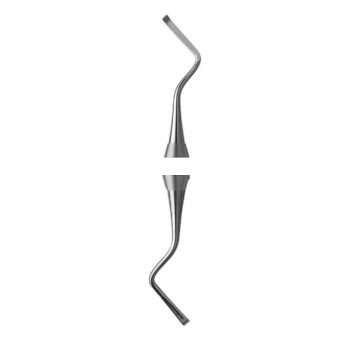
2R/2L Columbia University Curette pairs two working ends built to the classic Columbia pattern: parallel cutting edges that meet at a rounded toe rather than a pointed tip, giving each blade a broader, more forgiving working surface than a Gracey-style area-specific curette. The 2R and 2L ends mirror each other, letting the clinician adapt the same instrument to either side of a tooth or arch without switching to a second curette.This is a universal curette pattern rather than an area-specific one, so it's reached for across supragingival and light subgingival scaling and root planing on most tooth surfaces, rather than being matched to one specific tooth group the way a numbered Gracey is.It's a staple curette for general hygiene appointments, kept alongside the practice's Gracey and Langer curettes as the broad, general-purpose option for surfaces that don't call for a more specialized blade angle.Manufactured from medical-grade stainless steel, corrosion resistant and rated for full autoclave sterilization without losing edge sharpness or shank rigidity over repeated cycles.It's stocked alongside SurgiWorld's full Gracey and Langer curette sets, so a hygienist building out a scaling tray for a specific access angle or tooth group has the matching instrument on hand rather than adapting a different pattern to the job.
HS89

8/9 Orban Hoe Scaler

CAD 79.99
8/9 Orban Hoe Scaler shares the same spoon-shaped, single-edge blade construction as the 6/7 pattern, set at a different shank angle to reach tooth surfaces the 6/7 cannot approach as cleanly. Kept alongside the 6/7 rather than in place of it, this pattern rounds out supragingival calculus removal coverage across more of the arch, letting a clinician switch angles as the surface being scaled changes. Manufactured from medical-grade stainless steel, corrosion resistant, fully autoclavable.
HS67

6/7 Orban Hoe Scaler

CAD 79.99
6/7 Orban Hoe Scaler has a spoon-shaped blade set at an angle to the shank, with a single cutting edge built to remove supragingival calculus with a controlled pull stroke rather than a shaving or crushing action. The angled blade lets the edge engage the tooth surface just below the deposit and lift it away in one motion, which suits ledges of calculus sitting above the gumline where visibility and access are more open. The double-ended design pairs two complementary angles on the same handle for adjacent tooth surfaces. Manufactured from medical-grade stainless steel, corrosion resistant, fully autoclavable.
FS1213

12/13 Orban File Scaler

CAD 79.99
12/13 Orban File Scaler carries the same double-ended, file-textured head design as the 10/11 pattern, set at a wider shank angle built for posterior proximal surfaces that the 10/11's angle does not reach as effectively. Kept alongside the 10/11 rather than replacing it, this pattern rounds out proximal coverage across the posterior arch, so a clinician can match the file's angle to the specific surface being treated instead of forcing one angle to work everywhere. Manufactured from medical-grade stainless steel, corrosion resistant, fully autoclavable.
FS1011

10/11 Orban File Scaler

CAD 79.99
10/11 Orban File Scaler has double-ended, flat file-textured heads set on angled shanks, built to crush and smooth heavy or burnished calculus deposits that a bladed curette or scaler has trouble engaging directly. The multiple parallel cutting edges across the file head break down deposit into smaller pieces on the working stroke, making it easier for a follow-up curette to remove what remains. The two ends are angled differently so the pair reaches proximal root surfaces from complementary directions without changing instruments. Manufactured from medical-grade stainless steel, corrosion resistant, fully autoclavable.
PS193D

Posterior Sickle Scaler N3, Slim Dual-Edge Access

CAD 59.99
Posterior Sickle Scaler N3 is a periodontal instrument built for everyday posterior calculus removal, pairing dual cutting edges with a slim shank that carries a slight contra-angle for posterior access. Where an extreme contra-angle limits an instrument to light scaling near tight contacts, and a heavier, longer-bladed design is reserved for stubborn deposits, this slim dual-edge design covers routine supragingival posterior scaling in between. Double-ended, medical-grade stainless steel, corrosion resistant, fully autoclavable. It fits the same general size and use category as other posterior sickle scalers already familiar to hygienists, making it a straightforward addition to a standard scaling tray.
PS191D

Anterior Sickle Scaler N1, Disc and Sickle Combo

CAD 59.99
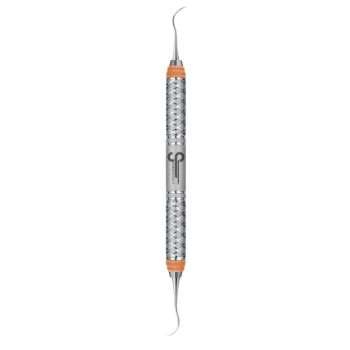
Anterior Sickle Scaler N1 is a periodontal instrument built for the lingual surfaces of anterior teeth, combining two different working ends in one double-ended handle. One end carries a curved disc blade with a cutting edge along its full curve, built to clear heavy supragingival lingual deposits with a pull stroke in horizontal, vertical, or oblique directions. The opposite end is a thin sickle tip suited to interproximal deposits and stain sitting right at the line angle. Medical-grade stainless steel, corrosion resistant, fully autoclavable. It fits the same general size and use category as other anterior scalers already familiar to hygienists, making it a straightforward addition to a scaling tray built for anterior lingual surfaces.
PS194D

Posterior Sickle Scaler N4, Heavy Deposit Remover

CAD 59.99
Posterior Sickle Scaler N4 is a periodontal instrument built for posterior calculus removal where deposits are heavier, burnished, or more tenacious than routine supragingival plaque. Its reinforced shank adds rigidity beyond a typical thin sickle pattern, while the longer, tapered dual blades get under stubborn deposits without excessive flexing. Double-ended, medical-grade stainless steel, corrosion resistant, fully autoclavable. It fits the same general size and use category as other posterior sickle scalers already familiar to hygienists, making it a straightforward addition to a scaling tray built for heavier calculus cases.
PS911D

Maverick Universal Scaler, Slim-Profile Sickle

CAD 59.99
Maverick Universal Scaler is a double-ended sickle scaler inspired by the popular Montana Jack design, built to deliver the same thinned-blade feel for tighter interproximal access than a standard-thickness sickle scaler. The contra-angled shank conforms closely to tooth anatomy, letting the pointed, triangular-cross-section tip adapt to a wide range of surfaces rather than being limited to one area of the mouth. Mirror-image tips on each end cover mesial and distal surfaces without switching instruments mid-appointment. The knurled, non-slip handle is lightweight and shaped to reduce hand fatigue during a full day of scaling. Double-ended, medical-grade stainless steel, corrosion resistant, fully autoclavable.
PCB12D

Barnhart 1/2 Universal Curette, Extended Reach

CAD 59.99
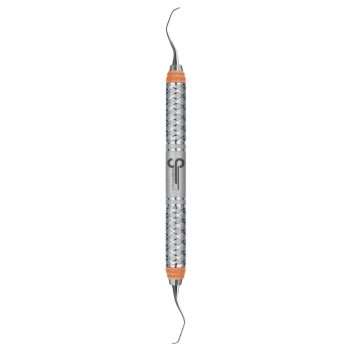
Barnhart 1/2 Curette is a double-ended universal curette with two cutting edges per end and a terminal shank longer than the Barnhart 5/6, giving it extended reach around posterior teeth. Because it is a universal instrument rather than an area-specific one, the 1/2 scales both mesial and distal surfaces of a tooth without the clinician switching instruments. The thin, sharp cutting edge slips easily under tight tissue, making it well suited to light to moderate calculus and general subgingival and supragingival scaling across most areas of the mouth. Double-ended, medical-grade stainless steel, corrosion resistant, fully autoclavable. It is a practical addition to a hygiene tray for clinicians who want one universal curette that adapts to more surfaces than a shorter-shanked pattern allows.
PC287D

Rigid After Gracey 13/14 Curette, Extended Distal Reach

CAD 59.99
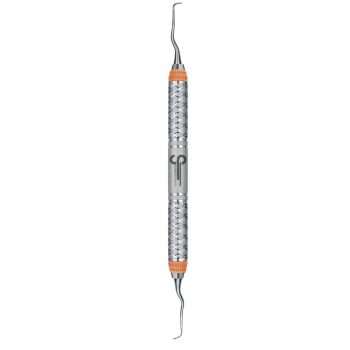
Rigid After Gracey 13/14 Curette combines two shank modifications in one instrument: the terminal shank is 3mm longer than a standard Gracey 13/14, the same extension used on the After pattern, and the shank is also thicker and stiffer than either the standard or the After version. That combination is built for distal posterior pockets that are both deeper than 5mm and carrying moderate to heavy calculus, a situation where a standard-length shank cannot bypass the crown or occlusion and a thinner After shank would flex before the deposit releases. The blade keeps its standard full width and the same 70-degree offset cutting edge found across the Gracey 13/14 family. Double-ended, medical-grade stainless steel, corrosion resistant, fully autoclavable. It is chosen specifically for deep pockets on second and third molars during active periodontal therapy.
PC286D

Rigid After Gracey 11/12 Curette, Extended Mesial Reach

CAD 59.99
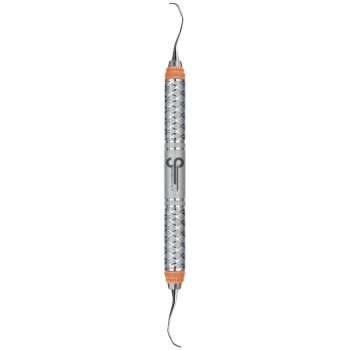
Rigid After Gracey 11/12 Curette combines two shank modifications in one instrument: the terminal shank is 3mm longer than a standard Gracey 11/12, the same extension used on the After pattern, and the shank is also thicker and stiffer than either the standard or the After version. That combination is built for mesial posterior pockets that are both deeper than 5mm and carrying moderate to heavy calculus, a situation where a standard-length shank cannot bypass the crown and a thinner After shank would flex before the deposit releases. The blade keeps its standard full width and the same 70-degree offset cutting edge found across the Gracey 11/12 family. Double-ended, medical-grade stainless steel, corrosion resistant, fully autoclavable. It is chosen specifically for deep pockets during active periodontal therapy rather than routine maintenance.
PC277D

Rigid Gracey 13/14 Curette, Posterior Distal

CAD 59.99
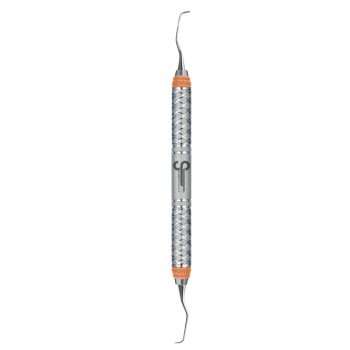
Rigid Gracey 13/14 Curette targets the distal surfaces of posterior teeth, built specifically for moderate to heavy calculus rather than light maintenance deposits. It keeps the same multi-angled shank and single 70-degree offset cutting edge as a standard Gracey 13/14, so it still slides past the distal contact and adapts to root curvature the same way. The shank itself is thicker and stiffer than the standard pattern, letting the clinician apply more lateral pressure without the instrument flexing before the deposit breaks free. This makes it a better fit for gross debridement and periodontal surgery on distal posterior surfaces than a standard-flex 13/14. Double-ended, medical-grade stainless steel, corrosion resistant, fully autoclavable. It is almost always stocked alongside the Rigid 11/12 so both mesial and distal surfaces can be completed with matching heavy-calculus instruments.
PC276D

Rigid Gracey 11/12 Curette, Posterior Mesial

CAD 59.99
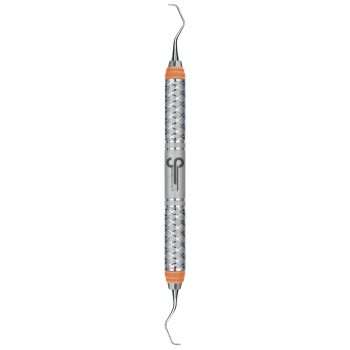
Rigid Gracey 11/12 Curette targets the mesial surfaces of posterior teeth, built specifically for moderate to heavy calculus rather than light maintenance deposits. It keeps the same multi-angled shank curvature and single 70-degree offset cutting edge as a standard Gracey 11/12, so it still reaches the tight interproximal spaces of molars and premolars where universal curettes struggle to adapt. The shank itself is thicker and stiffer than the standard pattern, allowing the clinician to apply more lateral pressure without the instrument flexing before the deposit breaks free. This makes it a better choice for gross debridement and periodontal surgery on mesial posterior surfaces than a standard-flex 11/12. Double-ended, medical-grade stainless steel, corrosion resistant, fully autoclavable. It is typically paired with the Rigid 13/14 for complete posterior coverage.
PC274D

Rigid Gracey 7/8 Curette, Posterior Facial and Lingual

CAD 59.99
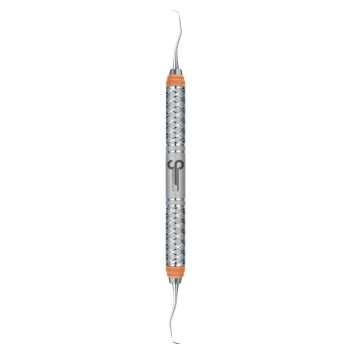
Rigid Gracey 7/8 Curette is an area-specific instrument for the facial and lingual surfaces of posterior teeth, built for cases where calculus is moderate to heavy rather than light. The blade keeps the same single cutting edge offset at 70 degrees found on a standard Gracey 7/8, so it still adapts closely to molar and premolar contours while the passive opposite edge protects the gingival tissue. What changes is the shank, which is thicker and stiffer than the standard version, letting the clinician apply more lateral pressure without the shank flexing before the deposit releases. That makes it a better fit for gross scaling and periodontal surgery on posterior facial and lingual surfaces than a standard-flex shank. Double-ended, medical-grade stainless steel, corrosion resistant, fully autoclavable. It is commonly paired with the Rigid 11/12 and 13/14 for a full heavy-calculus posterior set.
PC271D

Rigid Gracey 1/2 Curette, Anterior

CAD 59.99
Rigid Gracey 1/2 Curette is an area-specific hand instrument built for anterior teeth where calculus deposits are moderate to heavy rather than light and burnished. It keeps the same single cutting edge offset at 70 degrees and the same blade curvature as a standard Gracey 1/2, so the blade still adapts closely to incisor and cuspid root anatomy. The difference is the shank: it is thicker and stiffer, which lets the clinician apply more lateral pressure without the shank flexing under load. That added rigidity is useful for gross debridement and periodontal surgery on anterior teeth, where a standard-flex shank would bend before the calculus lets go. Double-ended, medical-grade stainless steel, corrosion resistant, fully autoclavable. Many practices stock the Rigid alongside a standard 1/2 and reach for whichever matches the calculus load that day.
DP212B

CP12 & Williams Double-Ended Probe

CAD 44.99
The CP12 / Williams Double-Ended Probe is an essential diagnostic tool designed for accurate measurement of periodontal pocket depths and gingival health. This versatile instrument combines two of the most widely used measurement scales into a single handle, streamlining the examination process. One end features the CP12 (3-6-9-12mm) scale, while the other utilizes the Williams (1-2-3-5-7-8-9-10mm) pattern. The markings are laser-etched in high-contrast black, ensuring they remain visible and easy to read even in areas with heavy moisture or limited light. Keeping both the CP12 and Williams scales on one handle is a practical choice for practices that see patients referred from offices using either standard.
XP611B

Explorer 6/Williams Probe, Non Color Coded

CAD 44.99
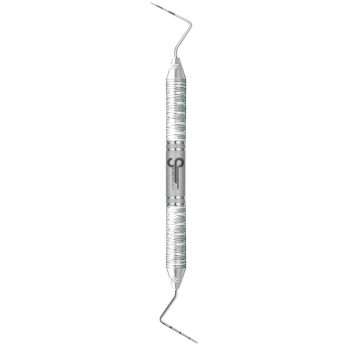
The Explorer 6 / Williams Probe is a double-ended diagnostic instrument that combines two of the most commonly used examination tools in dentistry on a single handle: a Number 6 explorer for tactile detection of caries, calculus, and restoration margins, and a Williams periodontal probe for pocket depth measurement and periodontal charting. The Williams end carries the standard 1-2-3-5-7-8-9-10 mm marking sequence, engraved directly into the stainless steel in this non-color-coded version - readable under operatory lighting without relying on paint or coating that can wear away over repeated sterilization cycles. Suitable for general examination, hygiene assessments, and periodontal recall appointments. Medical-grade stainless steel, autoclavable.
DP214B

UNC15/12 Color-Coded Periodontal Probe

CAD 44.99
UNC15/12 Color-Coded Periodontal Probe is a versatile diagnostic instrument that merges the UNC15 and University of Michigan #12 scales. It features distinct, easy-to-read black markings that resist fading even after repeated sterilization cycles. The dual-tip design allows practitioners to switch between measurement scales instantly, making it a staple for comprehensive periodontal charting and gingival health assessments.
PC257D

After Gracey 13/14 Curette, Extended Distal Reach

CAD 59.99
After Gracey 13/14 Curette is a specialized periodontal instrument engineered for deep subgingival root planing on the distal surfaces of posterior teeth. While maintaining the standard blade width, this After model features a terminal shank that is 3mm longer than the traditional 13/14. This extension is critical for accessing periodontal pockets deeper than 5mm, allowing the blade to reach the base of the pocket on second and third molars without the handle interfering with the patient's occlusion or the crown of the tooth. Double-ended, medical-grade stainless steel, corrosion resistant, fully autoclavable. It is chosen over the Mini 13/14 when the pocket is deep but the tissue is not unusually tight.
PC256D

After Gracey 11/12 Curette, Extended Mesial Reach

CAD 59.99
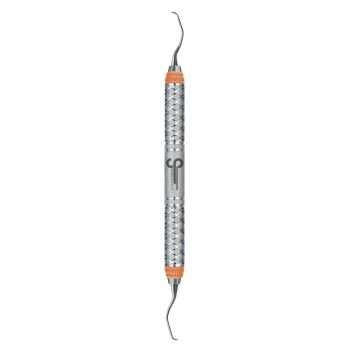
After Gracey 11/12 Curette is a specialized periodontal instrument designed for deep subgingival debridement on the mesial surfaces of posterior teeth. While it maintains the standard blade width of a traditional Gracey 11/12, the terminal shank is 3mm longer and the entire shank is thinned. These modifications let the clinician access periodontal pockets deeper than 5mm with ease, providing the clearance needed to bypass the crown of the tooth and reach the root surface without causing unnecessary tissue distension. Double-ended, medical-grade stainless steel, corrosion resistant, fully autoclavable. It is chosen over the Mini 11/12 specifically when the pocket is deep but the tissue is not unusually tight.
PC237D

Mini Gracey 13/14 Curette, Narrow Distal Pockets

CAD 59.99
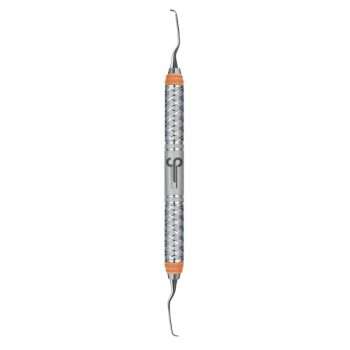
Mini Gracey 13/14 Curette is a specialized variation of the standard 13/14, engineered for deep, narrow periodontal pockets on the distal surfaces of posterior teeth. It features a blade 50 percent shorter than the standard pattern and a terminal shank that is 3mm longer than a standard Gracey. These modifications let the clinician reach root depths exceeding 5mm without distending the gingival tissue or losing the correct working angle in tight spaces. Double-ended, medical-grade stainless steel, corrosion resistant, fully autoclavable. It completes the narrow-pocket pairing with the Mini 11/12 for full posterior coverage in tight sites, and the two are typically ordered together.
PC236D

Mini Gracey 11/12 Curette, Narrow Mesial Pockets

CAD 59.99
Mini Gracey 11/12 Curette is a modified version of the standard 11/12, engineered for deep, narrow periodontal pockets on the mesial surfaces of posterior teeth. It features a blade 50 percent shorter than the standard pattern and a terminal shank that is 3mm longer than a standard Gracey. These modifications let the clinician reach root depths exceeding 5mm without distending the gingival tissue or losing the correct working angle in tight spaces. Double-ended, medical-grade stainless steel, corrosion resistant, fully autoclavable. It is stocked alongside the standard 11/12 specifically for sites where pocket depth and tissue tightness occur together, which is common in advanced periodontitis cases.
PC231D

Mini Gracey 1/2 Curette, Narrow Anterior Pockets

CAD 59.99
Mini Gracey 1/2 Curette is a specialized variation of the standard 1/2 Gracey, built for narrow periodontal pockets and tight tissue on anterior teeth. While it maintains the same familiar 70-degree blade angulation as the standard model, the Mini version features a 50 percent shorter blade and a longer terminal shank. These modifications let the clinician navigate deep subgingival areas without distending the gingival tissue or losing contact with the root surface in confined spaces. Double-ended, medical-grade stainless steel, corrosion resistant, fully autoclavable. It is chosen over the standard 1/2 specifically when the pocket is too narrow for the longer blade to enter cleanly.
PC132D

Younger-Good 7/8 Universal Curette

CAD 59.99
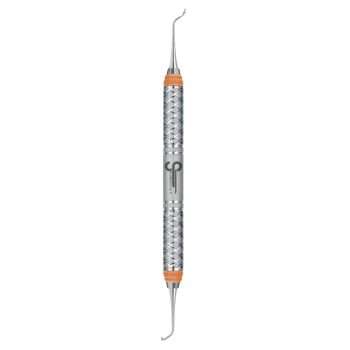
Younger-Good 7/8 Curette is a double-ended universal curette with two parallel cutting edges and a rounded toe, curved specifically to adapt to the facial and lingual surfaces of posterior teeth. The transition between quadrants happens without switching instruments, since both cutting edges on each end are sharp and usable. While built primarily for posterior surfaces, the curved blade also works effectively in anterior regions when a universal pattern is preferred over an area-specific curette. This makes it a practical general scaler for practices that want fewer instruments on the tray. Double-ended, medical-grade stainless steel, corrosion resistant, fully autoclavable. The balanced handle keeps the blade steady through repeated strokes across a full arch.
PS192D

Posterior Thin Sickle Scaler N2, Calculus Remover

CAD 59.99
Posterior Thin Sickle Scaler is a periodontal instrument designed specifically for supragingival calculus removal in the posterior region. Its unique, thin blade profile and specialized shank curvature provide access to the distal and mesial surfaces of molars and premolars where a standard-thickness sickle scaler is comparatively bulkier. The ultra-slender design allows the clinician to navigate tight interproximal spaces and reach under the contact points where traditional, thicker sickles often fail to fit. Double-ended, medical-grade stainless steel, corrosion resistant, fully autoclavable. It functions similarly to other slim posterior sickle patterns already familiar to most hygienists, making it an easy addition to an existing scaling tray.
PC221D

Gracey 17/18 Curette, Modified Distal Access

CAD 59.99
Gracey 17/18 Curette is the definitive tool for accessing the distal surfaces of second and third molars. Designed as a modification of the standard 13/14, this instrument features an exaggerated shank curvature and a slightly shorter blade. This specific geometry allows the clinician to navigate around the crown of the tooth and maintain a correct working angle even in extremely tight or restricted posterior spaces where a standard-shank instrument would bottom out against the ramus or adjacent tissue. Double-ended, medical-grade stainless steel, corrosion resistant, fully autoclavable. It is the instrument most clinicians switch to when the 13/14 cannot physically seat on a second or third molar.
PC219D

Gracey 15/16 Curette, Modified Mesial Access

CAD 59.99
Gracey 15/16 Curette is engineered specifically for deep scaling, root planing, and periodontal debridement of the mesial surfaces of posterior teeth. While it mirrors the blade curvature of a traditional 11/12, the 15/16 features a significantly increased shank angle. This modified geometry allows for a more neutral wrist position, providing good access to hard-to-reach molar areas where the standard 11/12 angle can force an awkward hand position. Double-ended, medical-grade stainless steel, corrosion resistant, fully autoclavable. Clinicians who find the 11/12 uncomfortable on second and third molars often switch to the 15/16 for the same mesial surfaces, since the change is in shank geometry rather than blade shape.
PC217D

Gracey 11/12 Curette, Posterior Mesial

CAD 59.99
Gracey 11/12 Curette is a core instrument for any periodontal kit, engineered specifically for the mesial surfaces of posterior teeth. This area-specific tool features a complex shank curvature that lets the blade reach deep into the interproximal spaces of molars and premolars where universal curettes often struggle to adapt. A single cutting edge offset at 70 degrees ensures effective calculus removal while the opposite terminal edge remains dull to prevent tissue trauma. Double-ended, medical-grade stainless steel, corrosion resistant, fully autoclavable. It is one of the most frequently reached-for instruments in a full-mouth scaling and root planing appointment, since nearly every posterior tooth has a mesial surface to address.
PC212D

Gracey 1/2 Curette, Anterior

CAD 59.99
Gracey 1/2 Curette is an area-specific hand instrument engineered for removing subgingival calculus and performing root planing on anterior teeth, specifically incisors and cuspids. Unlike a universal curette, this instrument has a single cutting edge offset at 70 degrees to the terminal shank, a geometry that adapts closely to the smooth, curved surfaces of front teeth while keeping the opposite dull edge away from the soft gingival tissue. That single-edge design reduces the risk of catching or nicking the sulcus during subgingival strokes on narrow anterior root surfaces. Double-ended, medical-grade stainless steel, corrosion resistant, fully autoclavable. It is the first curette most hygienists reach for when charting shows isolated pocketing on a front tooth.
PS811

Titanium Implant Scaler Langer 1/2

CAD 129.99
The Titanium Implant Scaler Langer 1/2 is a specialized periodontal instrument designed for the safe and effective cleaning of dental implants. Unlike standard stainless steel scalers that can scratch or contaminate titanium abutments, this instrument is made from high-grade medical titanium. The 1/2 model features a specific shank angulation tailored for the mandibular posterior teeth (lower molars and premolars). Using this tool ensures that you can remove plaque and calculus from the implant surface without compromising the integrity of the prosthetic components or the biocompatibility of the implant site.
PS131D

H5/33 Jacquette Scaler, Anterior Combo

CAD 59.99
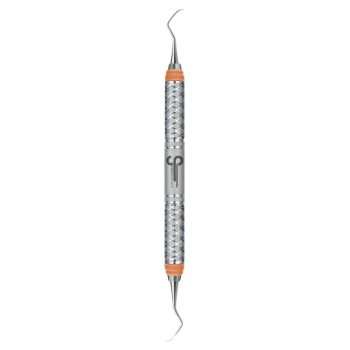
H5/33 Jacquette Scaler is a dual-ended hygiene instrument combining the H5 curved sickle with the #33 Jacquette straight blade on a single handle. It is built for removing supragingival calculus and stains across both narrow anterior spaces and broader tooth surfaces, since the two blade shapes give a clinician two different angles of attack without switching tools. The H5 end's fine, curved tip suits tight interproximal contacts, while the #33 end's straighter Jacquette blade covers wider surfaces more efficiently. Double-ended, medical-grade stainless steel, corrosion resistant, fully autoclavable. Combining two blade shapes on one handle keeps the scaling tray more compact during routine prophylaxis appointments.
PC131D

Barnhart 5/6 Universal Curette

CAD 59.99
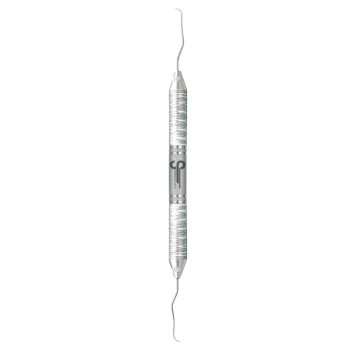
Barnhart 5/6 Curette is a double-ended universal curette with a thinner, longer terminal shank and two cutting edges per end, built to reach deep into periodontal pockets on posterior teeth. Because it is a universal instrument rather than an area-specific one, the 5/6 scales both mesial and distal surfaces of molars and premolars without the clinician switching tools mid-quadrant. The longer shank geometry gives it better access than shorter universal curettes when a pocket runs deep on a posterior tooth. This versatility streamlines scaling and improves chairside efficiency during hygiene appointments. Double-ended, medical-grade stainless steel, corrosion resistant, fully autoclavable. It is a common addition to a hygiene tray for practices that see a high volume of periodontal maintenance patients each day.
EX212B

ODU 11/12 Explorer, Extended Shank

CAD 44.99
ODU 11/12 Extended Shank Explorer is a double-ended diagnostic instrument built for pockets deeper than 5 mm, modified from the standard Old Dominion University 11/12 explorer with a terminal shank 3 mm longer to reach past the crown and tissue that interfere with the standard length. Like the standard ODU 11/12, each end carries a fine, flexible, curved tip used to detect subgingival calculus, root surface irregularities, and restoration overhangs by tactile feel. The extended reach makes it the version selected for advanced periodontal therapy rather than routine screening. Medical-grade stainless steel, corrosion resistant, fully autoclavable. Clinicians who regularly treat moderate to severe periodontitis often keep both the standard and extended shank versions on hand so the correct reach is always available chairside.
EX241B

3CH Cowhorn Explorer, Interproximal Access

CAD 44.99
3CH Cowhorn Explorer is a double-ended diagnostic instrument with a curved, pigtail-style tip that reaches interproximal areas and deep grooves a straight explorer cannot access. The curved design mimics a cow horn shape, giving the tip vibrational tactile sensitivity as it moves over calculus deposits, enamel defects, or restorative margins between teeth. It is used across both anterior and posterior teeth wherever interproximal contact areas need to be checked during a routine or diagnostic exam. Double-ended, medical-grade stainless steel, corrosion resistant, fully autoclavable. Because the curved tip transmits vibration clearly through the handle, many hygienists prefer it specifically for interproximal calculus checks during scaling appointments, where a straight explorer would otherwise need to be angled awkwardly to reach the same contact point.
PS171D

34/35 Jacquette Scaler, Posterior

CAD 59.99
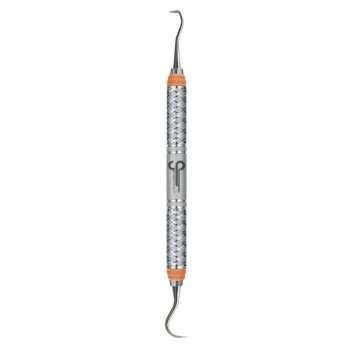
34/35 Jacquette Scaler is a posterior scaler with large, sturdy blades designed for the back of the mouth. It is built to handle heavy-duty scaling on the wide surfaces of molars, where a thinner or more delicate blade would risk bending under the pressure needed to remove tenacious deposits. Its lateral strength makes it possible to remove thick, stubborn calculus without the tool flexing during the procedure. Double-ended, medical-grade stainless steel, corrosion resistant, fully autoclavable. The larger blade size also covers more surface area per stroke than a fine-tipped scaler, which speeds up heavy posterior cleanups during a full initial scaling appointment.
PS153D

U-15 Towner/30 Jacquette Scaler

CAD 59.99
U-15 Towner/30 Jacquette Scaler is a hybrid instrument that merges the Towner U15 curved blade with the #30 Jacquette blade on a single double-ended handle. It provides a wide range of motion for removing heavy supragingival calculus, since the two blade shapes serve different clinical purposes on the same instrument. The U15 end is built for deep reaches into interproximal spaces, while the Jacquette end provides the leverage needed to pop off calcified deposits from the crowns of the teeth. Double-ended, medical-grade stainless steel, corrosion resistant, fully autoclavable. Combining both blade types on one handle reduces the number of scalers a clinician needs for heavy calculus cases.
PS152D

Nebraska 128 Sickle Scaler

CAD 59.99
Nebraska 128 Scaler is a delicate scaler with a very thin tip, used primarily for the removal of fine calculus and stains from the interdental spaces of anterior teeth. Its lightweight blade design offers high tactile sensitivity, letting a clinician feel small irregularities on the enamel surface that a thicker blade would miss. The narrow profile lets the tip enter interdental spaces cleanly without disturbing the surrounding papilla. Double-ended, medical-grade stainless steel, corrosion resistant, fully autoclavable. It is a common choice for finishing passes after heavier calculus has already been removed with a sturdier scaler, especially during a patient's regular recall visit.
PS151D

0/00 Morse Scaler, Miniature Blade

CAD 59.99
0/00 Morse Scaler features a very small, miniature blade, making it the choice for extremely tight contacts and crowded lower anterior teeth. Its reduced blade size allows for micro-scaling where standard-sized scalers are too bulky to seat between closely spaced teeth without risking soft tissue contact. The compact tip still carries a sharp, pointed edge capable of removing fine calculus deposits in these confined spaces. Double-ended, medical-grade stainless steel, corrosion resistant, fully autoclavable. It is an especially useful addition to a hygiene tray for pediatric patients or adults with significant lower anterior crowding, where a standard scaler simply cannot fit between the teeth.
PS132D

H6/H7 Hygienist Scaler, Anterior

CAD 59.99
H6/H7 Hygienist Scaler is a double-ended instrument built for efficient plaque and tartar removal on anterior teeth and premolars. This instrument features two sharp, super-thin sickle tips designed specifically for front teeth, with a shank curvature that allows for easy adaptation to tooth surfaces around the cervical line and into narrow interproximal gaps. Built for longevity, the stainless steel construction keeps the edges sharp through multiple uses and sterilization cycles. Double-ended, medical-grade stainless steel, corrosion resistant, fully autoclavable. The slender blade profile makes it a common choice for practices that see a high volume of anterior stain and calculus cases.
PS172D

31/32 Jacquette Scaler, Anterior and Premolar

CAD 59.99
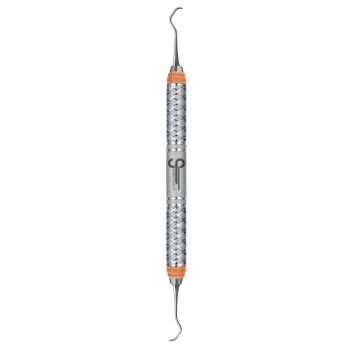
31/32 Jacquette Scaler is designed for anterior and premolar use, featuring medium-sized blades that offer a balance between strength and access. It is used for removing supragingival deposits from the facial and lingual surfaces, where a blade too large would be difficult to seat cleanly and one too thin would flex under moderate calculus loads. The angled shank allows for a comfortable hand position, giving the clinician better control and less strain during longer scaling sessions. Double-ended, medical-grade stainless steel, corrosion resistant, fully autoclavable. This balance of size makes it a versatile scaler for general prophylaxis appointments across a wide range of patients.
PC114D

Columbia 13/14 Universal Curette

CAD 59.99
Columbia 13/14 Curette is a double-ended universal curette with two cutting edges per end, built for removing light to moderate calculus and finishing root surfaces across anterior and posterior teeth. The rounded toe and dual cutting edges make it safe for subgingival use while still covering both mesial and distal surfaces from a single instrument. Its longer blade and shank give it better reach into deep periodontal pockets than a shorter universal curette, which is why clinicians reach for it specifically for finishing passes after initial calculus removal. Double-ended, medical-grade stainless steel, corrosion resistant, fully autoclavable. The balanced handle keeps grip fatigue low during longer scaling appointments.
PS134D

H5/U15 Towner Scaler, Anterior Combo

CAD 59.99
H5/U15 Towner Scaler is a dual-ended instrument combining the H5 straight sickle with the U15 Towner curved scaler on a single handle. It is built for removing supragingival calculus from interproximal spaces on anterior teeth, where the two different blade shapes give a clinician both a straight and a curved angle of attack without switching tools. The pointed tips on both ends allow for sharp access between tight teeth, making it a practical choice for initial hygiene appointments and heavy stain removal on front teeth. Double-ended, medical-grade stainless steel, corrosion resistant, fully autoclavable. Combining two blade shapes on one handle also keeps the scaling tray more compact.
PS112D

204SD Sickle Scaler, Posterior Distal

CAD 59.99
204SD Sickle Scaler is a double-ended hygiene instrument specifically designed for posterior supragingival scaling. While similar to the standard 204S, the SD version features a more flexible and slightly thinner shank, along with a specialized blade angulation that excels in reaching the distal surfaces of molars. This design allows the clinician to adapt the blade more easily to the varying contours of posterior teeth, making it an effective choice for removing moderate to heavy calculus in areas with tight tissue or restricted access. Double-ended, medical-grade stainless steel, corrosion resistant, fully autoclavable. It is commonly stocked alongside the 204S rather than as a replacement for it.
PS154

U15/33 Sickle Scaler

CAD 39.99
A staple in every hygiene kit, the U15/33 combines two different sickle shapes for comprehensive anterior cleaning. It is used to scrape away plaque and hardened tartar from the visible parts of the teeth. The sturdy stainless steel construction ensures the tips remain sharp and effective for high-volume dental practices.
XP241

23/Williams Explorer Probe, Slim Non-Color Handle

CAD 44.99
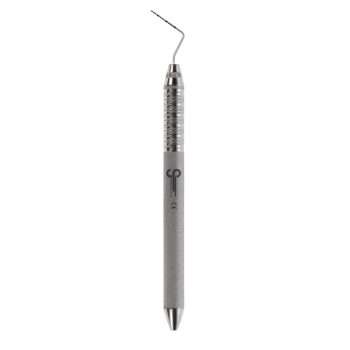
23/Williams Explorer Probe is a dual-ended diagnostic instrument combining the #23 Shepherd's Hook explorer with a Williams periodontal probe on a slim handle, marked with permanently engraved, non-color-coded bands at 1, 2, 3, 5, 7, 8, 9, and 10 mm. Unlike a painted or coated probe, the engraved markings stay legible after repeated sterilization cycles since there is no coating to wear away. The slim handle profile is built for enhanced tactile feedback during caries detection and pocket depth measurement. Double-ended, medical-grade stainless steel, corrosion resistant, fully autoclavable. Practices that run high sterilization volumes often prefer this engraved version specifically because there is no color coating left to fade or wear over time.
DP121B

UNC 15 Periodontal Probe

CAD 39.99
The UNC 15 Periodontal Probe is a single-ended dental instrument used for measuring periodontal pocket depths, gingival attachment levels, and sulcus dimensions during routine dental exams and periodontal assessments. Developed at the University of North Carolina (UNC), this probe follows one of the most widely adopted calibration standards in periodontics used by dental professionals globally.
DP211B

CP12/CP11.5B Double-Ended Probe

CAD 44.99
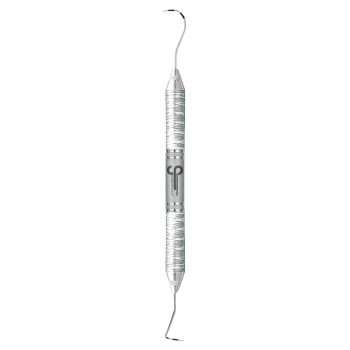
CP12/CP11.5B Probe is a double-ended periodontal probe that combines the whole-millimeter CP12 scale on one end with the offset half-millimeter CP11.5B scale on the other, giving a clinician both reference systems in a single handle. This pairing removes the need to switch between two separate probes when a borderline reading needs a half-millimeter reference point mid-exam. It is chosen by clinicians who want both scales without carrying two separate instruments. Double-ended, medical-grade stainless steel, corrosion resistant, fully autoclavable. Keeping both scales on one handle also reduces instrument clutter on the tray during a full periodontal charting appointment, which matters during longer comprehensive exams.
DP122B

CPQ2N Probe, Color-Coded 3-6-9-12mm

CAD 44.99
CPQ2N Probe is a single-ended, color-coded periodontal probe marked at 3, 6, 9, and 12 mm for broad, general-purpose pocket depth measurement. The color banding makes each threshold easier to identify at a glance than plain engraved lines, which speeds up reading in low light or bleeding sulci. Its even 3 mm spacing and 12 mm maximum reach make it suited to general charting across shallow, moderate, and deeper pockets in one probe. Single-ended, medical-grade stainless steel, corrosion resistant, fully autoclavable. The 12 mm maximum reach also means this probe rarely needs to be swapped out mid-exam, even when a deeper pocket is unexpectedly encountered.
DP123B

2N Nabers Furcation Probe

CAD 44.99
The 2N Nabers Probe is the essential diagnostic tool for accurately assessing furcation involvement in multi-rooted teeth. Designed specifically for periodontal examinations, this double-ended instrument features a curved working end that allows easy access to the complex anatomy of molar and premolar roots. The ergonomic handle provides a steady grip, ensuring tactile sensitivity when navigating deep periodontal pockets or subgingival areas. A straight periodontal probe cannot enter a furcation at the correct angle, which is why this curved-tip design is a required addition to the tray rather than an optional extra for any practice treating periodontal patients on a regular basis.
DP213B

GF/CPQW Double-Ended Probe, 1-10mm

CAD 44.99
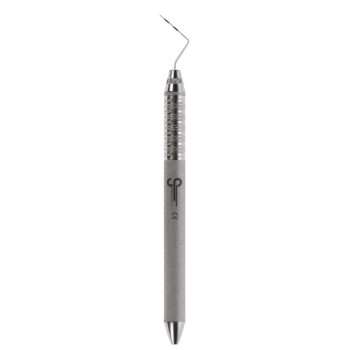
GF/CPQW Probe is a double-ended periodontal probe combining the Goldman-Fox marking scale on one end with the CPQW scale on the other, both covering the 1 to 10 mm range clinicians reference most during routine charting. This pairing gives a clinician access to two established marking conventions on one handle, useful in practices where staff were trained on different systems. It is chosen when standardizing on a single probe for a mixed-training team matters. Double-ended, medical-grade stainless steel, corrosion resistant, fully autoclavable. New associates trained elsewhere can use their familiar scale immediately without the practice needing to restock a second probe type just for them.
DP119B

Marquis Probe CP12

CAD 39.99
The Marquis Probe CP12 is a single-ended, color-coded periodontal probe used for measuring gingival pocket depths, recording clinical attachment levels, and assessing overall periodontal health during dental exams. The Marquis name refers to its distinctive alternating color-band design, a widely recognized format across dental practices and hygiene programs for its speed and ease of reading during charting.
XP281B

Explorer Probe EXP23/UNC15

CAD 44.99
The Explorer Probe EXP23/UNC15 is a dual-ended dental instrument that combines two of the most widely used diagnostic tools in a single, balanced handle, the EXP 23 shepherd’s hook explorer and the UNC 15 periodontal probe. This combination makes it a go-to choice for clinicians looking to streamline their tray setup without compromising diagnostic accuracy.
XP271B

Explorer Probe EXP23/CP12

CAD 44.99
A versatile diagnostic instrument with a Shepherd’s Hook and a CP12 probe marked at 3-6-9-12mm intervals for general periodontal screening. The Explorer Probe EXP23/CP12 is a dual-ended dental diagnostic instrument that pairs the EXP 23 shepherd’s hook explorer with the CP 12 color-coded periodontal probe. Designed for everyday clinical use, this combination instrument reduces instrument switching during patient exams, keeping tray setups lean and chair time efficient.
XP261B

23/CP11.5B Explorer Probe, Ball Tip

CAD 44.99
23/CP11.5B Explorer Probe is a dual-ended diagnostic instrument combining the #23 Shepherd's Hook explorer with a ball-tip CP11.5B periodontal probe marked at 3.5, 5.5, 8.5, and 11.5 mm, following WHO-style probing conventions used across general and specialist practice. The rounded ball tip is designed to detect subgingival calculus and early-stage attachment loss without catching or gouging root surface irregularities the way a sharp tip can. Double-ended, medical-grade stainless steel, corrosion resistant, fully autoclavable. Practices that follow WHO periodontal screening protocols specifically often standardize on this probe pattern to keep their screening data consistent across patients and across every clinician on the hygiene team.
XP251B

23/CP11 Explorer Probe

CAD 44.99
23/CP11 Explorer Probe is a dual-ended diagnostic instrument combining the #23 Shepherd's Hook explorer with a CP11 periodontal probe marked at 3, 6, 8, and 11 mm, giving a fast, clear read on gingival health alongside routine caries detection. The probe's clearly spaced bands make pocket depth easy to read at a glance, while the explorer end checks occlusal pits and restoration margins in the same pass. Double-ended, medical-grade stainless steel, corrosion resistant, fully autoclavable. Hygienists often reach for this combination specifically during recall appointments where speed and clarity matter as much as thoroughness across a full arch of sites.
XP221B

23/CP10 Explorer Probe

CAD 44.99
23/CP10 Explorer Probe is a dual-ended diagnostic instrument combining the #23 Shepherd's Hook explorer with a CP10 periodontal probe marked at 1, 2, 3, 5, 7, 8, 9, and 10 mm, built for detailed periodontal assessment alongside routine caries detection. The near-continuous probe scale gives finer resolution than a widely spaced probe, letting a clinician track small pocket depth changes at the same time the explorer end checks for cavities and margin defects. Double-ended, medical-grade stainless steel, corrosion resistant, fully autoclavable. This level of detail is particularly useful during periodontal maintenance visits where small shifts in pocket depth need to be caught early.
DP112

CP2 Probe, 2mm Increment Probe

CAD 44.99
CP2 Probe is a single-ended periodontal probe with an even-numbered scale marked every 2 mm from 2 to 12 mm, giving a complete pocket depth picture across the full clinically relevant range. The consistent 2 mm spacing makes it a general-purpose probe suited to any standard periodontal exam, rather than a probe built for one specific screening or tracking task. It is commonly the default probe stocked in a general-purpose diagnostic kit. Single-ended, medical-grade stainless steel, corrosion resistant, fully autoclavable. Because the spacing never skips a 2 mm interval, hygienists often prefer it for recall exams where consistent tracking against a previous chart matters.
XP231B

Explorer Probe EXP23/Williams

CAD 44.99
Features the EXP23 tip and a Marquis-style CPQW probe with markings at 1-2-3-5-7-8-9-10mm for consistent depth readings. The 23/Williams Explorer Probe (EXP23/CPQW) is a dual-ended dental diagnostic instrument that combines the EXP 23 shepherd’s hook explorer and the Williams color-coded periodontal probe in a single balanced handle. It is one of the most widely used explorer-probe combinations in dental practices worldwide, trusted for both routine oral exams and full-mouth periodontal charting.
DP118B

CP11.5B Probe, Half-Millimeter Scale

CAD 44.99
CP11.5B Probe is a single-ended periodontal probe marked at 3.5, 5.5, 8.5, and 11.5 mm, offering half-millimeter reference points that fall between the whole-millimeter bands used on standard probes. This offset scale is used when a clinician wants an additional reference point between adjacent whole-millimeter readings, helping distinguish borderline pocket depths. It is typically stocked alongside a whole-millimeter probe as a paired option for practices that want both scales available. Single-ended, medical-grade stainless steel, corrosion resistant, fully autoclavable. This is particularly useful when a recorded depth sits right at a treatment-decision threshold, where the extra half-millimeter reading can clarify whether monitoring or intervention is the better next step.
DP113B

CP8 Probe, 3-6-8-11mm

CAD 44.99
CP8 Probe is a single-ended periodontal probe with clinical markings at 3, 6, 8, and 11 mm, spaced to highlight the depth thresholds that separate healthy sulci from moderate and deep periodontal pockets. The clear gaps between bands reduce eye strain when scanning multiple sites during a full-mouth exam, letting the clinician identify a pocket needing attention without lingering on each site. It is used during routine periodontal charting where flagging moderate to deep pockets quickly is the priority. Single-ended, medical-grade stainless steel, corrosion resistant, fully autoclavable. The wider gaps between bands also make this probe easier to read correctly in a bleeding sulcus, where fine engraved lines close together are harder to distinguish.
DP114B

CP10 Probe, 1-10mm Scale

CAD 44.99
CP10 Probe is a single-ended periodontal probe marked at 1, 2, 3, 5, 7, 8, 9, and 10 mm, giving detailed, near-continuous depth readings across the full clinically relevant pocket range. The closer spacing of bands compared to a screening probe gives finer resolution for tracking small changes in pocket depth between recall appointments. It is used when detailed full-mouth periodontal charting is the goal rather than a quick screening pass. Single-ended, medical-grade stainless steel, corrosion resistant, fully autoclavable. This level of detail is particularly useful when a patient's periodontal status is being monitored closely following active treatment, where small depth changes need to be caught early.
DP115B

CPGF Probe, Goldman-Fox Marking

CAD 44.99
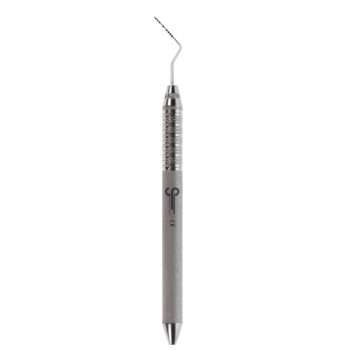
CPGF Probe is a single-ended periodontal probe marked at 1, 2, 3, 5, 7, 8, 9, and 10 mm following the Goldman-Fox marking convention used in many periodontal charting protocols. The banding pattern gives detailed depth resolution across the full clinically relevant pocket range, matching the scale clinicians trained on the Goldman-Fox system already read by habit. It is chosen specifically by practices standardizing on the Goldman-Fox convention for staff training consistency. Single-ended, medical-grade stainless steel, corrosion resistant, fully autoclavable. Dental schools that teach the Goldman-Fox system specifically often standardize on this probe so students carry the same reference scale from training into clinical practice.
DP116B

Williams Periodontal Probe

CAD 39.99
The Williams Periodontal Probe CPQW is a single-ended, color-coded dental probe used for periodontal pocket depth measurement, clinical attachment level recording, and gingival health assessment. It follows the Williams marking standard, one of the most established and globally recognized periodontal probe configurations used in dental practices, hygiene programs, and specialist periodontal clinics worldwide.
DP117B

CP11 Probe, 3-6-8-11mm

CAD 44.99
CP11 Probe is a single-ended periodontal probe with markings at 3, 6, 8, and 11 mm, used to identify moderate to deep periodontal pockets during routine and recall exams. The banding is spaced to flag clinically significant depth thresholds without requiring the clinician to count individual millimeter lines at each site. This makes it well suited to practices that want a fast, clear read during full-mouth probing. Single-ended, medical-grade stainless steel, corrosion resistant, fully autoclavable. Because the spacing is close to the CP8 pattern, some practices standardize on one or the other across their team simply for consistency in how depths are recorded.
DP111B

CPO Probe, 3-6-8mm Screening Probe

CAD 44.99
CPO Probe is a single-ended periodontal probe with high-contrast markings at 3, 6, and 8 mm, built for fast, routine pocket depth screening rather than detailed full-mouth charting. The simplified three-band scale lets a hygienist read a pocket depth at a glance without counting individual millimeter lines, which speeds up quick checkups and screening exams. It is chosen over a fully graduated probe specifically when screening speed matters more than capturing every intermediate millimeter. Single-ended, medical-grade stainless steel, corrosion resistant, fully autoclavable. Many practices keep a CPO Probe at the front desk chair specifically for new patient screening, where a fast first read matters more than tracking small changes over time.
EX251B

DG16 Endodontic Explorer, Canal Locator

CAD 44.99
DG16 Endodontic Explorer is a dedicated diagnostic instrument with long, sharp, straight tips designed to locate and open root canal entries during endodontic treatment. The fine, rigid tip geometry lets the clinician probe precisely at the base of an access cavity to distinguish a true canal orifice from surrounding dentin, including calcified or narrow canals. It is used specifically for endodontic access rather than general caries or periodontal screening. Medical-grade stainless steel, corrosion resistant, fully autoclavable. Because canal orifices can be difficult to distinguish from surrounding dentin by eye alone, this tip is often the deciding factor in locating a calcified canal before instrumentation begins.
EX261B

EXD 1 Explorer, Fine Flexible Tips

CAD 44.99
EXD 1 Explorer is a double-ended diagnostic instrument with thin, flexible tips suited for finding small cavities and assessing tooth enamel density. The fine tip flexibility gives the clinician sensitive tactile feedback on subtle changes in surface hardness, which is what distinguishes early demineralization or a small carious lesion from sound enamel. It is part of SurgiWorld's EXD-numbered explorer family, each built with a different tip geometry for a different diagnostic task. Double-ended, medical-grade stainless steel, corrosion resistant, fully autoclavable. Because the tips flex under light pressure rather than resisting it, this explorer is better suited to detecting subtle changes in surface texture than to applying firm probing pressure.
EX262B

EXD 2 Pigtail Explorer, Curved Twin Tips

CAD 44.99
EXD 2 Pigtail Explorer is a double-ended diagnostic instrument with two distinct curved ends that access different tooth surfaces, helping identify irregularities and rough spots on the enamel. The pigtail-style curvature on each end reaches surface angles a straight tip cannot sit against cleanly, giving broader surface coverage in a single instrument. It is used during routine exams when a clinician wants to check multiple surface angles for texture changes without switching instruments. Double-ended, medical-grade stainless steel, corrosion resistant, fully autoclavable. Hygienists often keep this explorer on the tray specifically for full-mouth surface screening, where checking several angles quickly matters more than probing any single site in depth.
EX263B

EXD 3 Pigtail Explorer, Interproximal Tips

CAD 44.99
EXD 3 Pigtail Explorer is a double-ended diagnostic instrument with curved, sharp tips designed for interproximal examination, reaching between teeth where decay often hides from direct visual inspection. The tightly curved pigtail geometry lets the tip slip into the contact area and follow the proximal surface down toward the gingival margin, checking for caries and calculus that a straight explorer would miss entirely. It is used specifically for interproximal work rather than open occlusal or buccal surface checks. Double-ended, medical-grade stainless steel, corrosion resistant, fully autoclavable. Because early interproximal caries frequently forms below the visible contact point, this tip is chosen specifically when a bitewing radiograph raises suspicion that needs tactile confirmation.
EX265B

EXD 5 Explorer, Heavy-Duty Shank

CAD 44.99
EXD 5 Explorer is a diagnostic instrument with a thicker shank than the rest of the EXD-numbered family, giving better leverage for checking firm calculus deposits and restorations. The added rigidity resists deflection when firm pressure is needed to distinguish hardened calculus from tooth structure, or to press against a restoration edge without the tip flexing away. It is used when a clinician needs more leverage than the finer EXD tips provide, rather than maximum tactile sensitivity. Medical-grade stainless steel, corrosion resistant, fully autoclavable. This makes it the preferred choice when a clinician is confirming whether a deposit is true calculus or simply a stained but sound area of enamel.
EX266B

EXD 6 Explorer, Posterior Access Tips

CAD 44.99
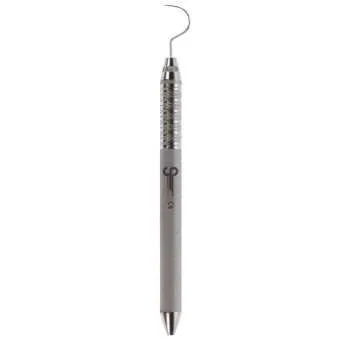
EXD 6 Explorer is a double-ended diagnostic instrument with two slender, angled tips built for reaching difficult posterior areas and checking for occlusal decay. The slim tip profile and angulation let the instrument access molar pits, fissures, and posterior surfaces that a bulkier explorer tip cannot enter cleanly. It is used specifically for posterior occlusal screening where access is the limiting factor rather than leverage or interproximal reach. Double-ended, medical-grade stainless steel, corrosion resistant, fully autoclavable. Hygienists commonly reach for it during full-mouth screening on molars specifically, where a straight or bulkier explorer would need repeated repositioning to check each pit and fissure.
EX154B

Explorer EXP 54, Subgingival and Furcation Tip

CAD 44.99
Explorer EXP 54 is a diagnostic instrument with uniquely angled tips built to identify subgingival irregularities and furcation involvement during periodontal exams. The angulation lets the tip follow the root surface into a furcation entrance and along the cementoenamel junction, areas a straight or hook-shaped explorer cannot enter at the correct angle. It is used specifically when a periodontal exam needs to confirm furcation involvement or subgingival root roughness rather than checking a supragingival restoration margin. Medical-grade stainless steel, corrosion resistant, fully autoclavable. This makes it a purpose-built addition to the periodontal tray rather than a general-purpose explorer used at every appointment, reserved specifically for cases where furcation status needs confirmation.
EX113B

Explorer EXP 3A, Fine Tip for Margins

CAD 44.99
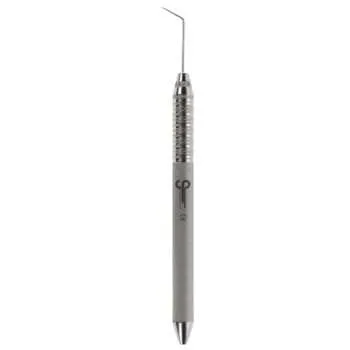
Explorer EXP 3A is a single-ended diagnostic instrument with a thin, wire-like 2 mm working tip built to enter deep, narrow pockets with tight tissue that a wider explorer cannot access. The straight shank supports both a vertical and horizontal stroke, letting the tip travel along a restoration margin or enamel surface to catch microscopic defects by feel rather than sight. Clinicians reach for the EXP 3A specifically when checking crown and filling margins for microfractures, ledges, or overhangs a visual exam alone would miss. Single-ended, medical-grade stainless steel, corrosion resistant, fully autoclavable. Its slim profile also makes it useful for confirming a suspected microfracture found visually under magnification, helping the clinician decide whether further restorative treatment is needed.
EX116B

Explorer EXP 6A, Rigid Tip for Margins

CAD 44.99
Explorer EXP 6A is a single-ended, rigid diagnostic explorer with a curved tip built for probing tight margins and checking the seal of crowns and bridges. The tip's added rigidity resists deflection when pressed firmly against a hard restoration margin, which is what lets a clinician confirm a tight seal rather than only detecting soft tissue or decay. This makes the EXP 6A the preferred choice for restorative recall exams checking existing crown and bridge work rather than general caries screening. Single-ended, medical-grade stainless steel, corrosion resistant, fully autoclavable. Because the tip resists flexing, it gives a more definitive answer than a thinner explorer when a clinician is deciding whether an existing restoration needs to be replaced.
XP211B

23/CP8 Explorer Probe

CAD 44.99
23/CP8 Explorer Probe is a dual-ended diagnostic instrument combining the #23 Shepherd's Hook explorer with a CP8 periodontal probe marked at 3, 6, 8, and 11 mm, letting a clinician check for caries and measure pocket depth without switching instruments. The explorer end catches on pit and fissure caries and restoration margins, while the probe end reads pocket depth at the clinically significant thresholds the CP8 scale is spaced for. This combination keeps tray setups lean for routine exams that need both functions. Double-ended, medical-grade stainless steel, corrosion resistant, fully autoclavable. Keeping both functions on one handle also reduces the number of instruments that need sterilizing between patients.
EX233B

EXD 23/6 Double-Ended Explorer

CAD 44.99
EXD 23/6 Explorer is a double-ended diagnostic instrument combining the #23 Shepherd's Hook with a #6 tip, giving the clinician two different working angles for comprehensive tooth surface inspection in a single instrument. The #23 end covers routine occlusal caries detection and margin checks, while the #6 end offers a second curvature for reaching surfaces at a different angle without repositioning the handle. This makes the EXD 23/6 a general-purpose double-ended option for clinicians who want angle variety rather than a specialized subgingival or endodontic second tip. Double-ended, medical-grade stainless steel, corrosion resistant, fully autoclavable. Because neither end is a specialized subgingival or endodontic tip, this explorer works well as an everyday general-purpose instrument for routine restorative and hygiene exams.
EX232B

23/DG16 Explorer for Caries and Canal Location

CAD 44.99
23/DG16 Explorer is a double-ended diagnostic and endodontic instrument that pairs the standard #23 Shepherd's Hook with a straight DG16 tip, used for caries detection and locating root canal orifices. The #23 end handles routine occlusal and margin exams, while the sharp, straight DG16 end is built to help locate calcified or narrow canal entries and probe decay at the base of a cavity preparation. This combination is chosen when a clinician wants one instrument that moves between general diagnostic work and endodontic access. Double-ended, medical-grade stainless steel, corrosion resistant, fully autoclavable. Clinicians who regularly move between restorative diagnosis and root canal access often keep this combination on the tray instead of two separate single-purpose explorers.
EX231B

23/TU17 Explorer for Caries and Subgingival Calculus

CAD 44.99
23/TU17 Explorer is a double-ended diagnostic instrument that combines the standard #23 Shepherd's Hook with a fine-angled TU17 tip on the opposite end, built for caries detection and subgingival calculus detection in deep periodontal pockets. The #23 end handles routine occlusal and margin checking, while the balanced TU17 tip is shaped for comfortable subgingival access where calculus deposits and root surface irregularities need to be felt rather than seen. This pairing lets one instrument cover both a general exam and a periodontal tactile check. Double-ended, medical-grade stainless steel, corrosion resistant, fully autoclavable. This combination is a common choice for periodontal recall appointments where both a general caries check and a subgingival tactile check are needed in the same visit.
EX123B

23 Shepherd's Hook Explorer

CAD 44.99
Shepherd's Hook Explorer #23 is a single-ended diagnostic instrument with a large, rounded hook tip used to detect pit and fissure caries and check the integrity of restoration margins. The hooked geometry catches on softened enamel and marginal ledges that a straight tip can slide past, giving moderate tactile sensitivity across occlusal surfaces. It is the most widely used explorer pattern in general practice and dental hygiene programs, and forms the base tip used on SurgiWorld's double-ended 23 combination explorers. Single-ended, medical-grade stainless steel, corrosion resistant, fully autoclavable. Because the hook shape is easy to recognize by touch, many clinicians reach for it first during a new patient or recall exam before switching to a more specialized tip.
EX211B

Explorer ODU 11/12

CAD 44.99
Explorer ODU 11/12 is a double-ended diagnostic instrument used to detect subgingival calculus, root surface irregularities, and restoration overhangs by tactile feel rather than direct vision. Each end carries a fine, flexible, curved tip, one shaped after the Gracey 11/12 curette and the other after the Columbia 13/14 curette, so the shank angle and curvature follow the same access pattern clinicians already rely on from those curettes to reach subgingival surfaces without traumatizing soft tissue. Independent in vitro research has found the ODU 11/12 explorer detects subgingival calculus more reliably than a standard periodontal probe. Medical-grade stainless steel, corrosion resistant, autoclavable.
PC218D

Gracey 13/14 Curette, Posterior Distal

CAD 59.99
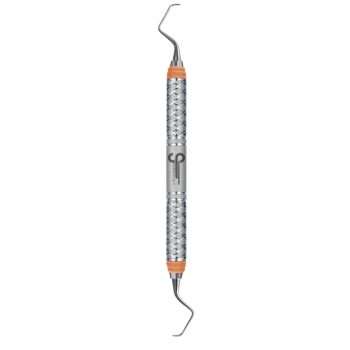
Gracey 13/14 Curette is an essential instrument designed for the most challenging areas of the mouth: the distal surfaces of posterior teeth. Its distinct, multi-angled shank allows for deep subgingival access to molars and premolars where straight instruments cannot reach. This area-specific design features a single cutting edge offset at 70 degrees, ensuring the blade adapts perfectly to the root curvature while the opposite side remains dull to protect the delicate sulcus lining from injury. Double-ended, medical-grade stainless steel, corrosion resistant, fully autoclavable. It completes the mesial-and-distal pairing with the 11/12 for full posterior root coverage, and the two are typically ordered together for any comprehensive periodontal kit.
PC216D

Gracey 9/10 Curette, Posterior Facial and Lingual

CAD 59.99
Gracey 9/10 Curette is an area-specific instrument for the facial and lingual surfaces of posterior teeth, offering a straighter blade profile as an alternative to the Gracey 7/8 for the same clinical zone. Like the 7/8, the cutting edge is offset at 70 degrees so only one side of the blade engages the tooth while the opposite edge stays passive against the gingival tissue. Some clinicians find the straighter blade easier to seat on wider molar surfaces where the 7/8's curvature can feel tighter than needed. Double-ended, medical-grade stainless steel, corrosion resistant, fully autoclavable. Practices building a full Gracey set typically choose one of 7/8 or 9/10, not both.
PC214D

Gracey 5/6 Curette, Anterior and Premolar

CAD 59.99
Gracey 5/6 Curette is an area-specific instrument that extends root planing coverage from anterior teeth into premolar surfaces, using the same single cutting edge offset at 70 degrees found across the Gracey series. Its slightly longer shank and blade than the 1/2 or 3/4 give it the reach needed for premolar surfaces while still adapting well to anterior teeth, which makes it a bridging instrument between the anterior-only Gracey patterns and the posterior-specific 7/8. The passive opposite edge continues to protect gingival tissue during subgingival strokes. Double-ended, medical-grade stainless steel, corrosion resistant, fully autoclavable. Many Gracey sets include the 5/6 specifically to avoid a coverage gap between anterior and posterior instruments.
PC213D

Gracey 3/4 Curette, Anterior

CAD 59.99
Gracey 3/4 Curette is an area-specific instrument for anterior teeth, offering a straighter single cutting edge as an alternative blade shape to the Gracey 1/2 for the same clinical zone. Like other Gracey patterns, the cutting edge is offset at 70 degrees to the lower shank, so only one side of the blade engages the root surface while the opposite edge stays passive and protects the sulcus. Some clinicians find the straighter blade easier to insert through tight anterior contacts than the more curved 1/2 pattern. Double-ended, medical-grade stainless steel, corrosion resistant, fully autoclavable. Practices that stock both 1/2 and 3/4 let each hygienist choose the blade shape that suits their technique.
PC111D

Columbia 4R/4L Universal Curette

CAD 59.99
Columbia 4R/4L Curette is a double-ended universal curette with two mirror-image cutting edges set at 90 degrees to the lower shank, used for supragingival and subgingival scaling on anterior and premolar tooth surfaces. Because both cutting edges are sharp, the same blade removes calculus on mesial and distal surfaces without switching to a second instrument, and the rounded toe keeps the tip safe for subgingival passes. It is a general-purpose curette rather than an area-specific one, so it adapts to a wider range of tooth surfaces than a Gracey pattern. Double-ended, medical-grade stainless steel, corrosion resistant, fully autoclavable. The mirror-image ends also mean a right-handed and left-handed clinician can use the same instrument with equal control.
DP124

CP-12 Color-Coded Probe

CAD 44.99
CP-12 Color-Coded Probe is a single-ended periodontal probe with 12 distinct color-coded markings used for quick, precise pocket depth measurement and general gum health assessment. The dense color-banded scale gives more reference points across the probing range than a probe with fewer bands, letting a clinician read subtle depth differences without recounting individual lines. It is used during periodontal exams that call for detailed depth tracking rather than a fast screening pass. Single-ended, medical-grade stainless steel, corrosion resistant, fully autoclavable. The dense banding is especially useful when documenting findings for a periodontal referral, where the receiving specialist benefits from more granular depth data.
PS111D

204S Sickle Scaler, Posterior

CAD 59.99
204S Sickle Scaler is a periodontal instrument engineered for the effective removal of supragingival calculus from posterior teeth. Featuring a contra-angle design, this double-ended scaler allows for access to the distal and mesial surfaces of molars and premolars without switching instruments. The sharp, pointed tips and rigid shank provide the strength needed to dislodge heavy, stubborn deposits while maintaining control at the tip. Double-ended, medical-grade stainless steel, corrosion resistant, fully autoclavable. Its triangular cross-section blade is thick enough to handle firm pressure on tenacious calculus without flexing or breaking during a stroke, and it holds its edge through repeated sterilization cycles.
PC215D

Gracey 7/8 Curette, Posterior Facial and Lingual

CAD 59.99
Gracey 7/8 Curette is an area-specific instrument for the effective removal of subgingival calculus and root planing on the facial and lingual surfaces of premolars and molars. The blade is offset at 70 degrees so only one cutting edge engages the tooth surface, while the opposite side remains passive to protect the soft gingival tissue during deep pocket cleaning. This design gives good access and adaptation on posterior surfaces where straight universal instruments often struggle to seat correctly. Double-ended, medical-grade stainless steel, corrosion resistant, fully autoclavable. It maintains a sharp edge through rigorous use and frequent autoclaving, which matters for an instrument used this often in a hygiene schedule.
DM112

Cone Socket Mirror Handle, Bliss

CAD 34.99
Cone Socket Mirror Handle is a reusable dental instrument handle with a friction-fit cone socket that accepts any standard cone-fitting mirror head, letting a clinic replace a scratched or worn mirror head without replacing the handle. The Bliss finish gives the handle a smooth, non-slip grip surface for stable control during intraoral retraction and examination. Because the socket is a simple push-fit connection, mirror heads can be swapped in seconds between patients or procedures. Medical-grade stainless steel, corrosion resistant, fully autoclavable. This makes it a practical stock item for practices that go through mirror heads faster than handles, since only the head needs replacing when it becomes scratched.
DM111

Cone Socket Mirror Handle, Diamond

CAD 34.99
Cone Socket Mirror Handle is a reusable dental instrument handle with a friction-fit cone socket that accepts any standard cone-fitting mirror head, letting a clinic replace a scratched or worn mirror head without replacing the handle. The Diamond finish gives the handle a textured, secure grip surface for stable control during intraoral retraction and examination. Because the socket is a simple push-fit connection, mirror heads can be swapped in seconds between patients or procedures. Medical-grade stainless steel, corrosion resistant, fully autoclavable. This makes it a practical stock item for practices that go through mirror heads faster than handles, since only the head needs replacing when it becomes scratched.

Buy 3 Get 1, until November 13

Buy 3, get 1 free

Mix and match any 4 forceps in stock. Put 4 in your cart and 1 comes off automatically. Buy 8 and 2 are free. While stock lasts.
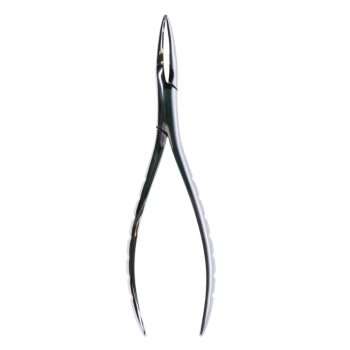
4 at $189.99 $759.96 $569.97 You save $189.99
FR300S

300 Root Forceps, Serrated

CAD 189.99
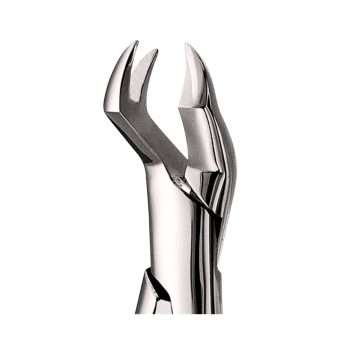
300 Root Forceps, Serrated is built for the upper arch, with narrow beaks that taper to fine, serrated tips shaped to close around a retained root fragment rather than an intact crown. When a crown has fractured off during extraction, or a root has been left behind from an earlier procedure, there's often no wide crown surface left for a standard forceps pattern to grip cleanly.The tapered beak profile lets the tips seat around a root that sits at or below the gumline, where a bulkier forceps head would have no clean purchase point. Fine serrations along each beak bite into the root surface just enough to hold it securely without crushing the narrow remaining structure, giving the clinician a controlled grip through delivery.This is a companion pattern to the lower-arch 301, kept alongside general extraction forceps specifically for retained-root cases in the upper arch - after a coronal fracture, an incomplete prior extraction, or any case where the crown is gone and only a root fragment remains to remove. Manufactured from medical-grade stainless steel, corrosion resistant, fully autoclavable, and rated for repeated sterilization cycles without losing beak alignment or serration sharpness over the life of the instrument.
FR88R

88R Nevius Upper Right Cowhorn Forceps

CAD 189.99
88R Nevius Upper Right Cowhorn Forceps are designed specifically for removing maxillary right first and second molars. The dual-pointed cowhorn beaks engage the buccal furcation and palatal root at root trunk level - bypassing crown contact and delivering extraction forces directly into the root complex. The 88R is a sided instrument, its beak offset is angled specifically for the upper right quadrant, ensuring correct anatomical alignment in the operator’s natural hand position. Highly effective on short-crown, heavily restored, or endodontically treated upper right molars. Stainless steel, fully autoclavable.
FR88L

88L Nevius Upper Left Cowhorn Forceps

CAD 189.99
The 88L is a sided instrument, it is specifically angled and offset for the upper left quadrant. Using a sided instrument ensures the beak points engage the correct anatomical landmarks on left-side molars with the natural hand position of the operator, improving control and reducing the risk of slippage during buccal and palatal luxation movements.
FR10S

10S Forceps, Upper Molar Extraction Forceps

CAD 189.99
The SurgiWorld 10S Forceps are stainless steel extraction forceps designed specifically for the removal of maxillary (upper) first and second molars. The paired beak design features one pointed beak that seats into the buccal furcation and one rounded beak that cradles the palatal root - providing a secure, multi-point grip across the tri-rooted anatomy of upper molars. With a universal design, a single instrument handles extractions on both the upper right and upper left sides. Built from corrosion-resistant stainless steel and fully autoclavable, these forceps are a standard addition to any extraction tray in general dentistry and oral surgery.
TF141

Adson Dressing Forceps, Serrated, Tungsten Carbide

CAD 159.99
The Adson Dressing Forceps Serrated Tungsten Carbide 12.5cm (4.9 inches) is a thumb forceps with Tungsten Carbide (TC) serrated tip inserts for firm and long-lasting grip on intraoral dressing materials, gauze, and wound packing agents. Tungsten Carbide is significantly harder than standard stainless steel, meaning the serrated jaw surface maintains its grip texture far longer under repeated use and autoclave cycles before any reduction in performance is noticed. This makes the TC version the preferred choice for high-volume dental practices and surgical clinics where instruments are used multiple times daily. Spring-open Adson frame for comfortable one-hand use. Fully autoclave-compatible.
TF131

Adson Dressing Forceps Serrated

CAD 99.99
The Adson Dressing Forceps Serrated is a thumb-style dental instrument featuring cross-serrated tips that provide a stronger, more controlled grip on wound dressings, gauze, suture materials, and soft tissue compared to the smooth-tip dressing version - without the sharp penetrating teeth of a tissue forceps. The serrated jaw pattern grips slippery or wet materials more securely, making this instrument particularly useful during intraoral procedures where standard smooth-tip forceps lose hold on moist gauze or dressing materials. The lightweight Adson spring-open frame allows comfortable one-hand use throughout dressing placement, removal, and intraoral material management. Fully autoclave-compatible.
FR1U

1 Upper Anterior Apical Forceps, Vertical Extraction for Incisors & Cuspids

CAD 189.99
The #1 Upper Anterior Apical Forcep is a specialized tool designed for the straightforward extraction of upper front teeth, specifically incisors and cuspids. This instrument features a straight handle and thin, tapered beaks that allow for deep penetration into the periodontal space. This “apical” design is crucial for gaining a firm purchase on the root surface, especially in cases where the crown is compromised or broken. The primary use is to apply vertical pressure and slight rotation to luxate the tooth from its socket while preserving the surrounding alveolar bone. Its streamlined shape ensures that you maintain a clear line of sight during the procedure. Doctors select the #1 Apical Forcep because it provides better tactile feedback compared to bulkier universal models, making it the top choice for atraumatic extractions in the aesthetic zone. The surgical-grade steel construction ensures a non-slip grip and long-term durability through heavy sterilization cycles.
FR150S

150S Dental Extraction Forceps, Upper Primary

CAD 189.99
The 150S Extraction Forcep is a compact version of the classic universal upper forceps, designed specifically for pediatric dentistry or adults with smaller alveolar arches. Featuring a shorter handle and smaller beaks, it provides good control when navigating the limited workspace of a child’s mouth. The primary use of the 150S is for the extraction of upper primary teeth (incisors, cuspids, and bicuspids), though it is also effective for smaller permanent upper teeth. Its curved beak design allows for a secure fit around the neck of the tooth, minimizing the risk of crown fracture. Practitioners choose the 150S because its reduced size improves tactile feedback and prevents the instrument from obstructing the line of sight during delicate procedures. Made from medical grade stainless steel, it is built to withstand repeated sterilization while maintaining its spring-like tension and grip.
DE221

Utility Plier

CAD 49.99
Utility Plier is a serrated-tip dental instrument used to handle cotton rolls, cotton pellets, and wedges with a secure, non-slip grip during general and restorative procedures. The angled design gives better visibility and reach in posterior regions of the mouth, letting a clinician place or remove material without the handle obstructing the line of sight. The interior serrations grip material firmly enough to carry medicated dressings to a cavity site without dropping them. Medical-grade stainless steel, corrosion resistant, fully autoclavable. This makes them one of the most frequently reached-for instruments on a general restorative tray, used many times throughout a single appointment.
FR18R

18R Upper Molar Extraction Forceps, Right Side with Thumb Hook

CAD 189.99
The No. 18R is the mirror-image counterpart to the 18L, specifically designed for extracting upper first and second molars on the patient's right side. It utilizes a side-specific beak configuration where the pointed tip engages the buccal root bifurcation of the right maxillary molars. This specialized fit allows for a more predictable extraction by spreading the force across the strongest parts of the tooth anatomy.
FR18L

18L Upper Molar Extraction Forceps, Left Side with Thumb Hook

CAD 189.99
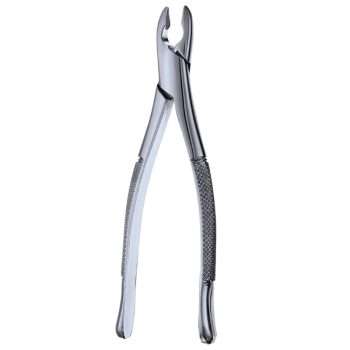
The No. 18L is a side-specific instrument engineered for the extraction of maxillary first and second molars on the patient's left side. Its anatomically shaped beaks feature a unique projection on the buccal (outer) side designed to fit into the bifurcation of the molar roots. This ensures a deep, non-slip seat on the tooth neck, which is critical for handling the three-rooted structure of upper molars.
FR99C

99C Kells Extraction Forceps

CAD 189.99
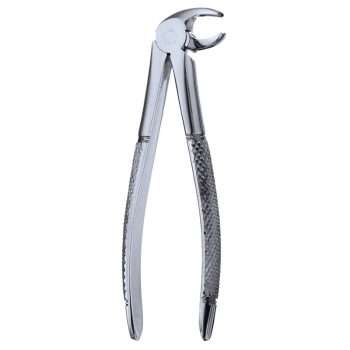
The No. 99C Kells Forceps is a specialized straight-handle instrument designed for the efficient extraction of maxillary anterior teeth. Named after the dental pioneer C. Edmund Kells, this pattern is favored by practitioners who prefer a slightly more robust beak compared to the standard No. 1. It provides a direct path of force for removing upper incisors and canines, ensuring the tooth is lifted vertically without unnecessary lateral stress on the alveolar bone.
FRMD4SA

MD4 Mead Extraction Forceps, Serrated, European Style

CAD 189.99
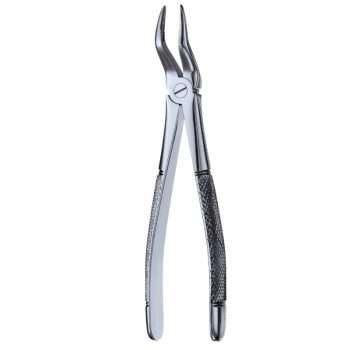
The MD4 Mead Forceps is a specialized instrument tailored for the removal of upper roots and small anterior teeth. Built with a "European Style" design, it features a more compact and streamlined profile compared to standard North American patterns. The integrated spring-action handle reduces manual effort, allowing the surgeon to maintain a consistent grip without needing to manually reset the handle width during the procedure.
FR51

51 Upper Root Extraction Forceps, Slim Bayonet Design for Maxillary Fragments

CAD 189.99
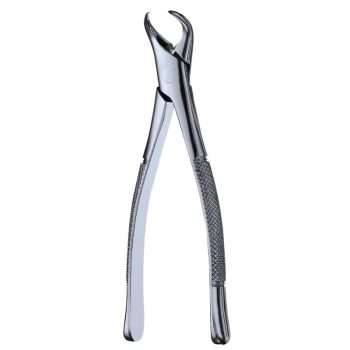
The No. 51 Forceps is a specialized surgical instrument designed for the removal of upper roots, root fragments, and narrow premolars. Its distinctive "Bayonet" shape features a long, offset neck that allows the practitioner to reach deep into the posterior regions of the upper jaw while maintaining a clear, unobstructed line of sight. The narrow, tapering beaks are specifically engineered to meet at the tips, providing a firm grip on small root surfaces that standard forceps cannot reach.
FR23

23 Cowhorn Extraction Forceps

CAD 189.99
The No. 23 Cowhorn Forceps is a specialized surgical tool designed specifically for the extraction of mandibular (lower) molars with decayed or accessible root bifurcations. Its distinctive, sharp, curved beaks resemble the horns of a cow, giving the instrument its name. Unlike standard forceps that grip the crown, the No. 23 is engineered to engage the space where the roots divide. By squeezing the handles, the pointed beaks act as a wedge, lifting the tooth coronally and often facilitating a much easier extraction in cases where the crown is severely damaged.
FR151

151 Universal Lower Extraction Forceps

CAD 189.99
The No. 151 Universal Lower Forceps is the industry standard for extracting teeth from the mandibular (lower) arch. This instrument is engineered to handle a broad range of teeth, including lower incisors, canines, and premolars. Its signature "Cryer" design features a downward-curved handle and beak alignment that provides the necessary clearance to work effectively within the lower jaw without hitting the upper teeth. For many dental practices, this is the primary "go-to" instrument for non-molar mandibular extractions.
FRMD4SB

MD4 Mead Forceps, Serrated, Matte Finish

CAD 189.99
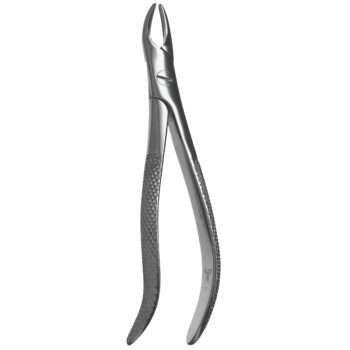
This version of the MD4 Mead Forceps features a specialized Matte Finish, designed specifically for surgeries performed under high-intensity LED operatory lights. By eliminating reflective glare, this instrument provides the dentist with better visual depth and reduces eye strain during long procedures. It retains the standard Mead geometry, making it perfect for upper root and small tooth extractions in the maxillary arch.
FR76S

76S Upper Roots Extraction Forceps, Serrated, European Style

CAD 189.99
Optimize your surgical accuracy with the 76S Upper Roots Serrated Extraction Forceps, specifically designed for the atraumatic removal of maxillary roots and fragments. Featuring a European Style handle, this instrument provides good ergonomics and a comfortable grip, ensuring maximum control during delicate extraction procedures
TF211

Corn Suture Tweezers

CAD 58.99
Corn Suture Tweezers are a fine-tipped surgical tweezer used to grip and place suture material securely during guided tissue regeneration and periodontal suturing procedures. The tip geometry holds fine suture thread without fraying or crushing it, which matters when placing delicate sutures around a membrane or graft site where excess tension could disrupt healing. This makes them well suited to periodontal and implant-related surgical procedures involving fine suture work. Medical-grade stainless steel, corrosion resistant, fully autoclavable. Surgeons placing resorbable membranes in particular rely on this gentle grip to avoid tearing delicate suture material during knot placement near the surgical site.
ED151

Rubber Dam Forceps, Palmer, 17.5cm

CAD 139.99
The Palmer Rubber Dam Forceps is a staple tool for achieving reliable tooth isolation. At 17.5cm in length, these forceps provide the necessary reach and leverage to position rubber dam clamps accurately over the anchor tooth, even in the most posterior regions of the mouth.
TF121

Adson Micro Tissue Forceps 1×2 Teeth

CAD 99.99
The Adson Micro Tissue Forceps 1×2 is a fine-tipped, toothed thumb forceps designed for firm, controlled grasping of soft tissue wound edges during intraoral suturing and surgical procedures. The 1×2 tooth configuration - one tooth on one tip interlocking with two teeth on the opposing tip - provides a secure, non-slip tissue hold with minimal tissue footprint, reducing crushing and tearing at the wound margin. The lightweight Adson frame delivers the tactile sensitivity needed for microsurgical tissue handling in periodontal, implant, and soft tissue surgical procedures. Fully autoclave-compatible stainless steel construction for routine sterilization.
FR86AE

86A Root Forceps, Lower Molars

CAD 189.99
  • For upper roots & fragments
  • Narrow tapered beak design
  • Stainless steel durable build
  • Ergonomic non-slip handle
  • Autoclavable & reusable
FR74A

74 Root Forceps, Serrated, European Style

CAD 189.99
The 74 Root Forceps, serrated, European style, are shaped for extracting lower roots and premolars. The narrow beaks follow the root anatomy, and the serrations give a firm grip that reduces slipping. A non-slip European style handle helps with control through longer procedures. Made from medical grade stainless steel, autoclavable and reusable.
FR22L

22 Lower Molar Forceps

CAD 189.99
  • The No. 22 Forceps is a fundamental tool for extracting lower molars, featuring the classic "Hawk’s Bill" right-angle design.
  • This configuration allows the dentist to approach the tooth from the side of the mouth, providing maximum leverage and a clear view of the lower dental arch.
  • Its perpendicular beak-to-handle alignment is specifically engineered to handle the high force required for multi-rooted mandibular molars.
FR150

150 Universal Upper Extraction Forceps

CAD 189.99
The No. 150 Universal Upper Forceps is a versatile, "all-in-one" instrument designed for the extraction of incisors, canines, and premolars in the maxillary arch. Its subtle "S" shape curve allows the practitioner to navigate around the patient's lips while maintaining a strong, vertical line of force. Because of its adaptable beak geometry, it is often the first choice for dentists looking for a multi-purpose tool that handles a wide range of upper-jaw procedures.
TF111

Adson Dressing Forceps

CAD 99.99
The Adson Dressing Forceps is a smooth-tip, thumb-style tissue handling instrument used in dental and oral surgical procedures for managing soft tissue, placing and removing wound dressings, packing surgical sites, and handling delicate intraoral materials without causing tissue trauma. Unlike toothed tissue forceps, the smooth jaws of the dressing version grip gauze, dressing materials, and sutures without puncturing or tearing surrounding tissue - making it the preferred choice whenever atraumatic handling of a wound site is needed. Lightweight stainless steel construction with a spring-tension handle design allows one-hand operation throughout the procedure.
FR111

Upper Anterior Extraction Forceps – Straight Beaks

CAD 189.99
Streamline your extraction procedures with Upper Anterior Forceps, specifically designed for the removal of upper incisors and canines. This instrument features a completely straight handle-to-beak alignment, allowing dental practitioners to apply controlled, linear force along the long axis of the tooth. This direct transmission of pressure is vital for minimizing the risk of root fractures during luxation.
FR89U

89 Cook Forceps

CAD 189.99
  • For upper left molars
  • Anatomical beak for accuracy
  • Stainless steel durable build
  • Ergonomic grip handle
  • Autoclavable & reusable
DE211

Merium Plier

CAD 44.99
Merium Plier is a one-piece spring-steel dressing plier with a gently curved, serrated tip built for everyday chairside pick-up work. The curve gives a slightly better line of sight and access angle than a straight pattern when reaching into the posterior of the mouth or a tray setup, while the serrated jaw holds cotton rolls, cotton pellets, gauze, and small restorative items securely without crushing them. Because it is a single-piece spring design rather than a pivot-hinge instrument, there is no joint to loosen or bind over repeated sterilization cycles, and tension is consistent from the first use to the last. A ribbed section along the shank gives a secure, non-slip hold even with gloved or damp hands, which matters during fast-paced restorative and hygiene appointments where an instrument gets picked up and set down dozens of times per patient. This pattern is one of the most frequently reached-for instruments in a general operatory, useful for placing and retrieving cotton rolls during isolation, positioning matrix bands and wedges, and handling small items on the tray without touching them by hand. Manufactured from medical-grade stainless steel, corrosion resistant, and fully autoclavable for repeated sterilization.

Procedural kits

Complete kits at kit prices

Each set ships in its own sterilization cassette, ready for the operatory.

How it works

  1. Pick your instrumentsAdd the instruments you need. Mix and match within each offer.
  2. Free items come offThe free items are taken off in your cart automatically. No code needed.
  3. Check out as usualPay by card, Apple Pay, Google Pay, or Klarna on orders of $500 or more. Free shipping across Canada over $50.

Offer details

How does Buy 7 Get 3 work?

Add any 10 scalers, curettes, explorers, probes and mirror handles and 3 are free, taken off in your cart automatically. Buy 20 and 6 are free. Ends November 13, 2026.

How does Buy 3 Get 1 work?

Add any 4 forceps in stock and 1 is free, taken off in your cart automatically. Buy 8 and 2 are free. In-stock items only, while stock lasts. Ends November 13, 2026.

Can I combine the offers?

Yes. Free-item offers and sale-priced kits work together in the same order.

Shipping and returns

Free shipping across Canada on orders over $50. Every order has a 30-day money back guarantee. Return policy

Ordering for a clinic, school or group?

Call +1 416 575 8177 or email sales@thesurgiworld.com and our team will build the order with you, offers included.

Limited-time offers, subject to change.

Shop the full range

  • CE marked, Health Canada MDEL licensed
  • 30-day money back guarantee
  • Free shipping across Canada on orders over $50
Back to Top
Product has been added to your cart