
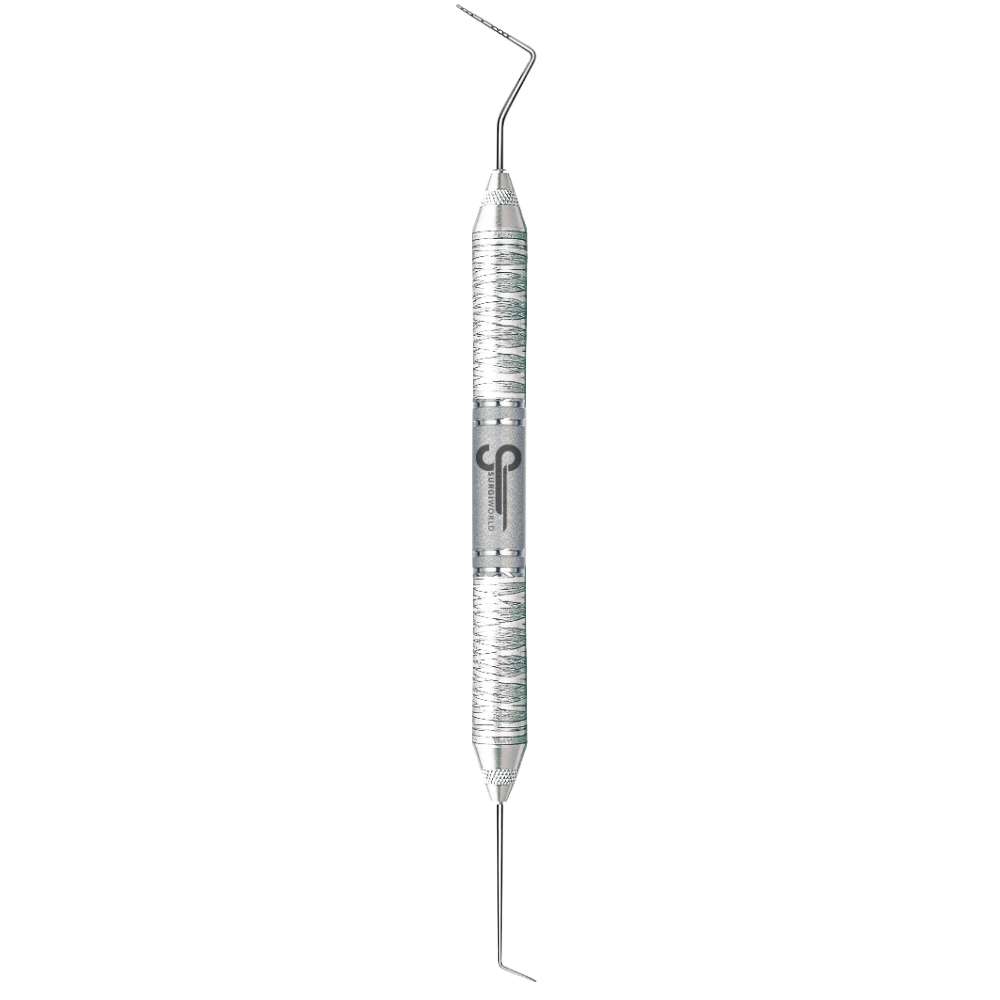
The Explorer 6/Williams Probe is a core diagnostic instrument for periodontal assessment and restorative examination. One end features a #6 explorer with an angled tip that allows the clinician to trace tooth surfaces, locate subgingival and supragingival calculus, check restoration margins, and detect demineralized or carious areas through fine tactile feedback. The opposing end is a Williams probe, the long-standing reference pattern for periodontal pocket depth measurement.
This listing is the non color coded variant. Instead of black or color bands, the depth graduations are machined as etched reference lines on the stainless working end. Many clinicians prefer this finish because there is no banding to chip, flake, or fade with repeated autoclave cycles, and the working end can be resharpened or repolished without losing visual reference. The Williams marking sequence runs 1, 2, 3, 5, 7, 8, 9, and 10 mm. The skipped 4 mm and 6 mm graduations are a defining feature of the Williams pattern and help the clinician read pocket depth quickly without misreading adjacent lines in tight or bleeding sites.
The instrument is manufactured from surgical-grade stainless steel for corrosion resistance and repeat sterilization. A lightweight, textured or hollow ergonomic handle improves grip control and reduces hand strain during full-mouth charting. The working ends are designed to retain a degree of flexibility so the clinician gets tactile response rather than a rigid, dead feel at the tip. As a double-ended instrument, it consolidates two essential examination functions, which reduces instrument count on the diagnostic tray and speeds up the assessment workflow.
Typical applications include periodontal screening and charting, caries detection, evaluation of restoration overhangs and open margins, and general intraoral examination. It is suited to general dentists, periodontists, and hygienists across diagnostic, recall, and treatment-planning appointments.




Reviews
There are no reviews yet.