
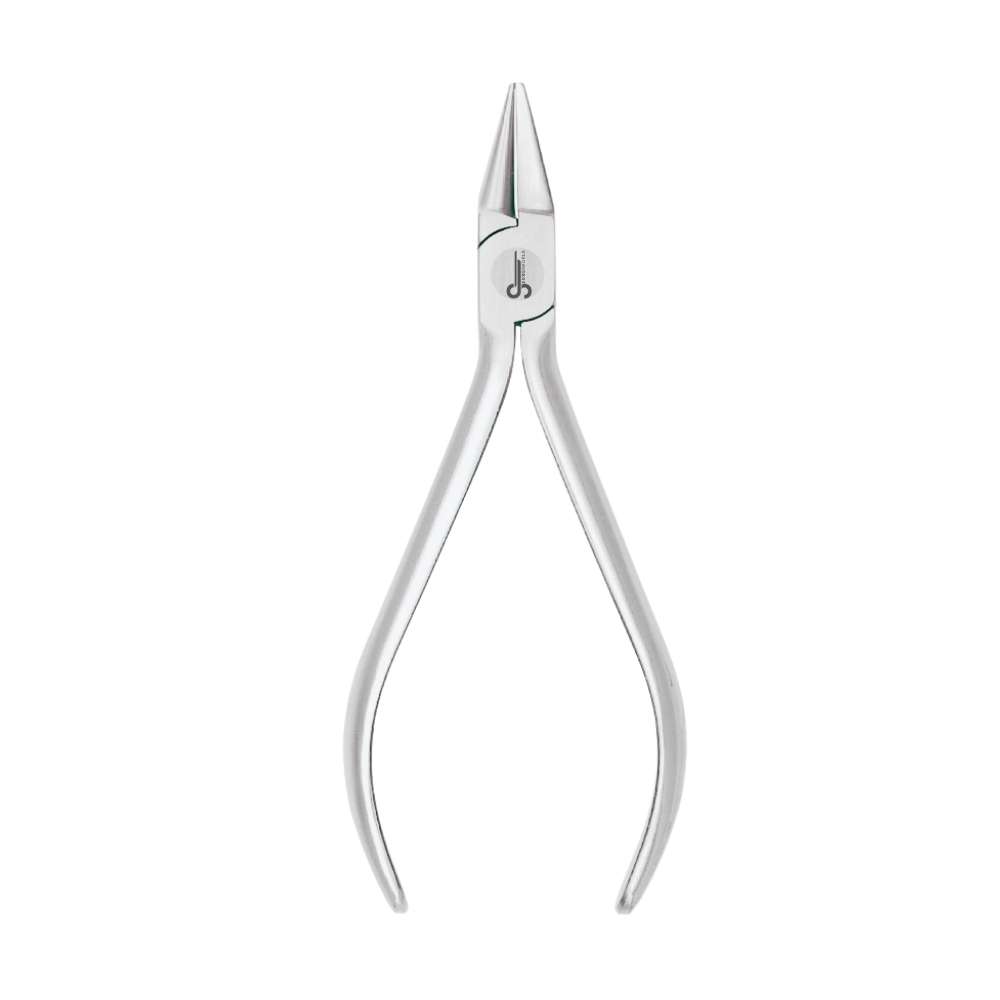
The initial phase of fixed appliance treatment uses the thinnest archwires in the sequence. These wires typically 0.014″ or 0.016″ round NiTi or stainless steel are flexible enough to engage crowded and misaligned brackets, but they require correspondingly fine bending instruments. Using a standard-beak bird beak plier on a 0.014″ wire places the wire against beak surfaces proportioned for heavier gauges, making precise loop placement difficult and increasing the risk of kinking the wire or creating an unintentional bend at the wrong position.
The Light Wire Bird Beak Plier solves this with an extended conical beak that is longer and tapers to a finer tip than the standard bird beak profile. The finer tip allows accurate placement of the wire at the exact position along the beak cone where the required loop diameter will form, with enough beak length to produce multiple loop sizes from a single instrument without repositioning. The extended beak length also makes it easier to duplicate loop positions along the archwire, critical when bilateral symmetry of loop placement is needed for Class II or Class III mechanics.
Wire capacity is up to .020″ (.51 mm), appropriate for initial-phase round wires, light retainer springs, and auxiliary wire components. For intermediate rectangular wires (0.017 × 0.025″ or 0.018 × 0.025″ stainless steel) and heavier gauges, the standard Bird Beak Pliers-2 is the correct instrument. The flat square beak remains functional for forming stops and step bends in light wire. Box joint construction maintains jaw alignment. Spring-return handles allow continuous loop-forming without manual reopening. Medical-grade stainless steel, autoclavable.


Reviews
There are no reviews yet.