
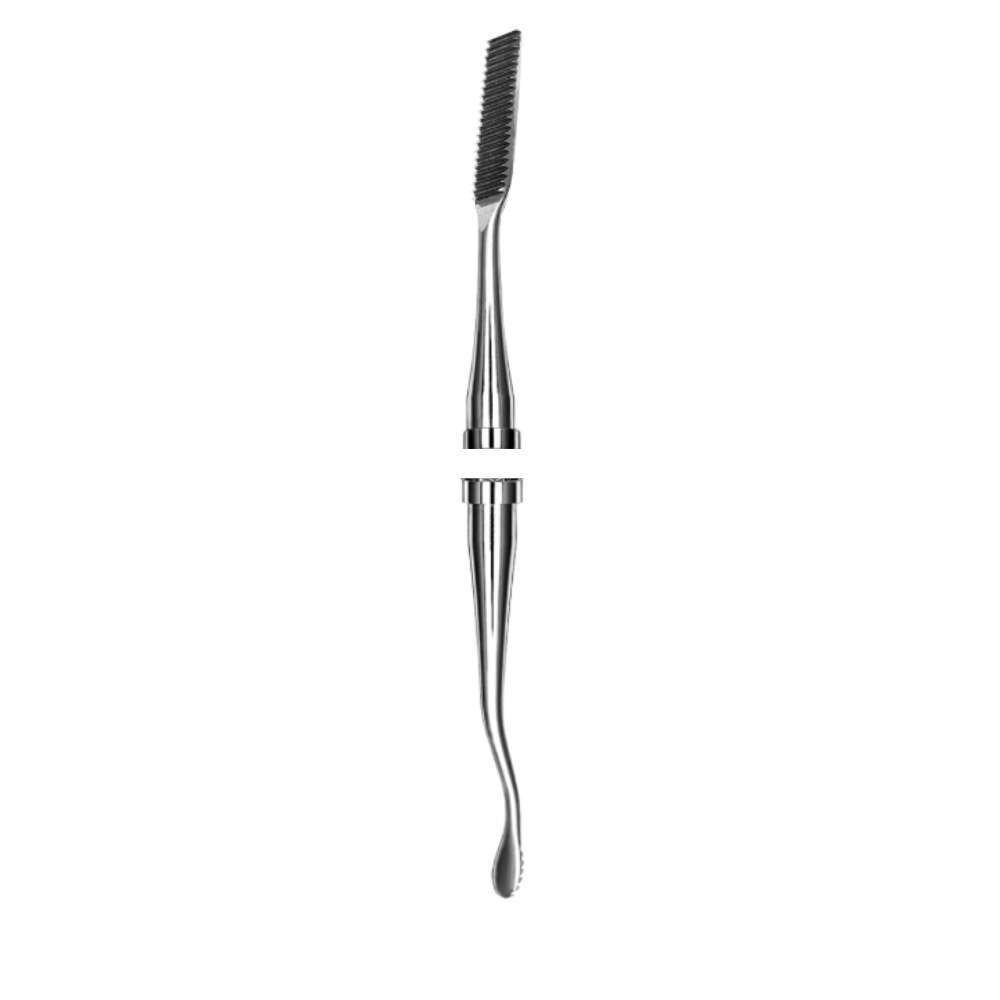
The 64 Miller bone file is chosen when a surgical site needs efficient two-direction bone smoothing in a narrower or more confined field than a wider file can access, such as posterior ridge sites or the margins of a small osseous defect. Its cross-cut serration removes bone on both the push and pull stroke, which reduces the number of passes needed compared to a straight-cut instrument working in a single direction only.
The double-ended design carries a 6.2 mm working end for general ridge smoothing and a narrower 4.8 mm end for tighter interproximal or defect access on the same handle, letting the clinician switch working widths without changing instruments mid-procedure. Because the cross-cut pattern engages bone in both directions, stroke pressure becomes the main control point for how much bone is removed per pass.
Clinically, the 64 Miller is reached for after chisel or rongeur bone removal to round sharp margins and smooth the ridge crest in sites where access is limited, and it is commonly used alongside other Miller-pattern cross-cut files when a case calls for varying working-end widths across the same procedure. Double-ended, medical-grade stainless steel, corrosion resistant, autoclavable.
Product Features
- 64 Miller Bone File 6.2 mm and 4.8 mm working ends cut on both push and pull strokes for faster bone smoothing
- Cross-cut serration reduces the number of passes needed compared to a straight-cut file
- Narrower working-end widths suit posterior ridge sites and confined osseous defects
- Double-ended handle carries two working widths for a single procedure
- Rounds sharp bone margins after chisel or rongeur bone removal
- Commonly used alongside other Miller-pattern cross-cut files for varying access needs
- Medical-grade stainless steel, corrosion resistant, fully autoclavable
64 Miller vs 21 Miller: The 64 Miller carries a cross-cut serration that removes bone on both the push and pull stroke, while the straight-cut 21 Miller cuts only on the pull stroke. The 64’s narrower 6.2 mm and 4.8 mm ends also suit tighter ridge and defect access than the 21’s wider 8.1 mm end. Reach for the 64 for faster two-direction smoothing in confined sites.


Reviews
There are no reviews yet.