
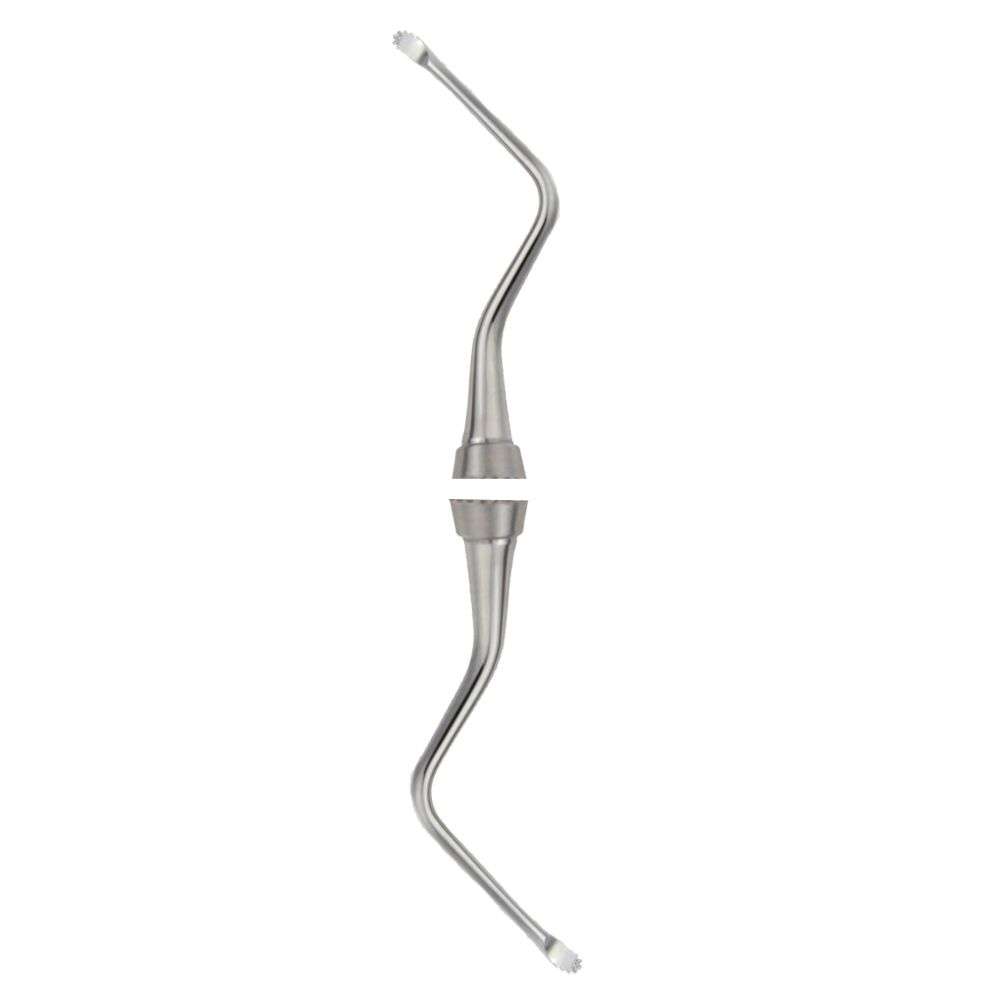
The 84 Lucas serrated surgical curette addresses a specific clinical requirement that the smooth-spoon version of the same instrument does not fully meet: the need to not only remove granulation tissue from the extraction socket but to simultaneously prepare the socket wall surface for optimal healing, whether that healing is intended for natural socket repair, ridge preservation grafting, or immediate implant placement. The serrated blade edge changes the interaction between the instrument and the socket wall in two clinically important ways.
First, the serrations grip the granulation tissue rather than simply sweeping beneath it. Granulation tissue in a post-extraction socket is often fibrous and adherent to the socket walls, particularly in infected sites or in sockets where the original periapical pathology extended laterally into the bone. A smooth spoon applied to this tissue may slip under a portion of it and remove it in segments, but fibrous tags and adherent tissue remnants frequently remain on the socket wall after smooth-spoon curettage. The serrated edge catches, grips, and tears through these tissue bundles in the working stroke, achieving more complete removal of the entire granulation tissue layer in fewer passes.
Second, the serrations score the cortical bone surface of the socket wall as the instrument is swept through the debridement stroke. This scoring action disrupts the cortical bone surface and induces fresh bleeding from the socket walls, which is the biological prerequisite for graft integration in socket preservation procedures and for osseointegration of the cortical socket wall surface surrounding an immediately placed implant. A smooth socket wall with intact cortical bone may not bleed adequately to support graft particle revascularization, while a scored surface provides the bleeding points and surface irregularity that promote early graft contact and vascular ingrowth.
At 2 mm, this is the smallest serrated spoon in the Lucas serrated series, suited to the same narrow socket dimensions as the smooth-spoon #84: anterior incisors, maxillary and mandibular canines, narrow premolar sockets, and the apical third of any socket where the root taper brings the socket walls close together. The 50° angled terminal shank and elongated spoon geometry are consistent with the standard Lucas series design, providing socket base access without extreme handle repositioning. Double-ended with mirror-image serrated spoons. Medical-grade stainless steel, corrosion resistant, autoclavable at standard pre-vacuum steam parameters, compatible with ultrasonic cleaning prior to sterilization.
Product Features
- 84 Lucas serrated surgical curette 2 mm serrated spoon grips and disrupts adherent granulation tissue more completely than a smooth-spoon curette in a single working stroke
- Serrated outer edges score the socket wall cortical bone surface, inducing fresh bleeding that supports graft integration in socket preservation and immediate implant placement procedures
- Smallest serrated Lucas spoon at 2 mm – enters narrow anterior and premolar sockets and the apical third of tapered sockets where larger serrated spoons would contact the lateral walls
- Double-ended mirror-image serrated spoons provide right and left socket wall coverage from one instrument
- 50° angled terminal shank accesses the socket base and lateral walls without extreme handle repositioning
- Distinct from the smooth-spoon Lucas #84 – select this version when socket preservation, implant site preparation, or infected socket thorough debridement is the clinical objective
- Medical-grade stainless steel, corrosion resistant, fully autoclavable; compatible with ultrasonic cleaning prior to sterilization
Differentiates from 84 Lucas Smooth Spoon: The smooth-spoon Lucas #84 uses a plain curved cutting edge for controlled sweeping debridement. This serrated version carries fine teeth along the outer blade edge that grip and disrupt granulation tissue more aggressively and score the socket wall to induce fresh bleeding, a distinct clinical function suited to socket preservation and implant site preparation where smooth-spoon curettage alone may leave viable granulation tissue on the socket walls.



Reviews
There are no reviews yet.