
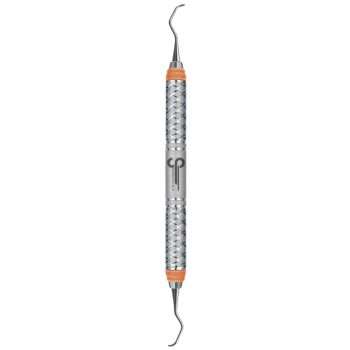
The Gardner bone chisel 9 completes the tip-geometry range of the Gardner series with a rounded blade profile, distinct from the flat tip on the #1 and #2, the pyramid tip on the #5, and the diamond wedge tip on the #6. The curved cutting edge is built to follow contoured bone surfaces rather than cut in a straight line, which reduces the risk of gouging when the ridge or defect margin is curved or concave.
At 4 mm blade width, the #9 is sized to match the #2 and #6, but its rounded profile is reserved for sites where the bone contour itself is curved, such as the posterior curvature of the alveolar ridge or the margins of a concave osseous defect, where a flat or angular tip would only partially contact the surface or catch on the transition.
Clinically, the #9 is selected when the shaving target follows a curve rather than a flat or point-loaded irregular surface, making it a companion instrument to the flat-tip #1 and #2 and the point or wedge tips on the #5 and #6 rather than a replacement for them. Single-ended, medical-grade stainless steel, corrosion resistant, autoclavable.
Product Features
- 9 Gardner Bone Chisel 4 mm rounded-tip mono-bevel follows curved ridge contours without gouging
- Curved cutting edge conforms to concave or contoured bone surfaces rather than cutting in a straight line
- Completes the Gardner tip range alongside the flat #1/#2, pyramid #5, and diamond wedge #6
- Mallet-compatible round platform handle for combined hand pressure and mallet-assisted removal
- Single-ended design for directional control in ridge and implant site preparation
- 4 mm blade width matches the #2 and #6 Gardner chisels
- Medical-grade stainless steel, corrosion resistant, fully autoclavable
9 Gardner vs 6 Gardner: Same 4 mm blade width, but the #9’s rounded tip follows curved or concave bone contours, while the #6’s diamond wedge tip is built to wedge through dense, resistant bone on flatter surfaces. Choose by surface geometry, not just density.





Reviews
There are no reviews yet.