
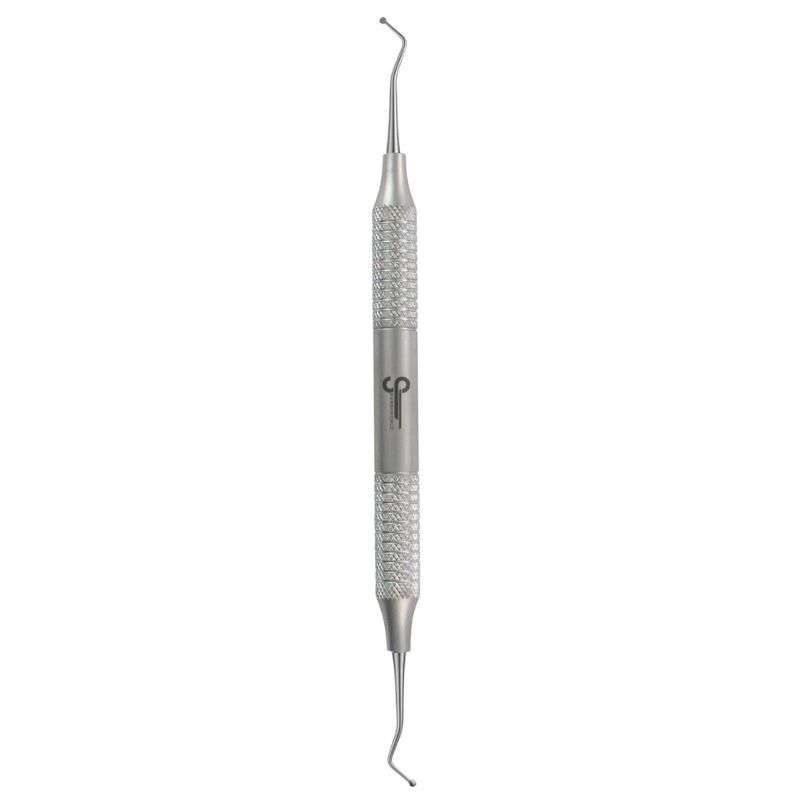
The 18 dental spoon excavator is the default caries removal instrument in the numbered series. At 1.5 mm, the blade width covers a preparation floor area that is well-matched to the dimensions of most Class I occlusal preparations in permanent posterior teeth and the pulpal floor dimensions of moderate-sized Class II preparations. The 1.5 mm spoon removes carious dentin efficiently without requiring the accuracy-focused, stroke-by-stroke approach needed with the 1.2 mm #17, and without needing the large-cavity-specific bulk removal technique used with the 2.0 mm #19.
In clinical use, the #18 is typically the first excavator applied after the caries access cavity has been opened with a bur. The initial excavation removes the bulk of the soft carious dentin from the preparation floor and walls, with the spoon sweeping in lateral arcs until the resistance of the dentin under the blade changes from soft and yielding to firm. At this point, if the preparation depth or any remaining areas of discolouration require investigation, the #17 at 1.2 mm is the appropriate step-down instrument for targeted fine excavation in those specific zones without disturbing the surrounding sound dentin that the #18 has already reached.
The numbered series shank configuration of the #18 provides a specific blade-to-handle geometry that positions the 1.5 mm spoon at the correct offset for comfortable intraoral access in the posterior arch, where the majority of caries removal procedures occur. Double-ended with mirror-image spoons, medical-grade stainless steel, corrosion resistant, autoclavable. Maintain blade sharpness; a dull spoon requires more lateral force to cut through carious dentin, reducing tactile discrimination between soft and hard tissue.
Product Features
- 18 dental spoon excavator standard 1.5 mm blade is the most commonly used excavator size in routine restorative caries removal
- Efficient 1.5 mm coverage of the preparation floor suits Class I posterior and Class II proximal preparations as the initial excavation instrument
- Step down to #17 for fine work near the pulp; step up to #19 for large preparations requiring bulk removal
- Double-ended mirror-image spoons for bilateral preparation wall access from one instrument
- Medical-grade stainless steel, corrosion resistant, fully autoclavable; keep blades sharp for accurate tactile feedback
18 vs 17 and 19: The #18 is the standard mid-range instrument in this numbered series. Use the #17 when the preparation is too small or too close to the pulp for a 1.5 mm blade. Step up to the #19 when the preparation is large enough that the 1.5 mm blade requires too many strokes for efficient bulk excavation.


Reviews
There are no reviews yet.